

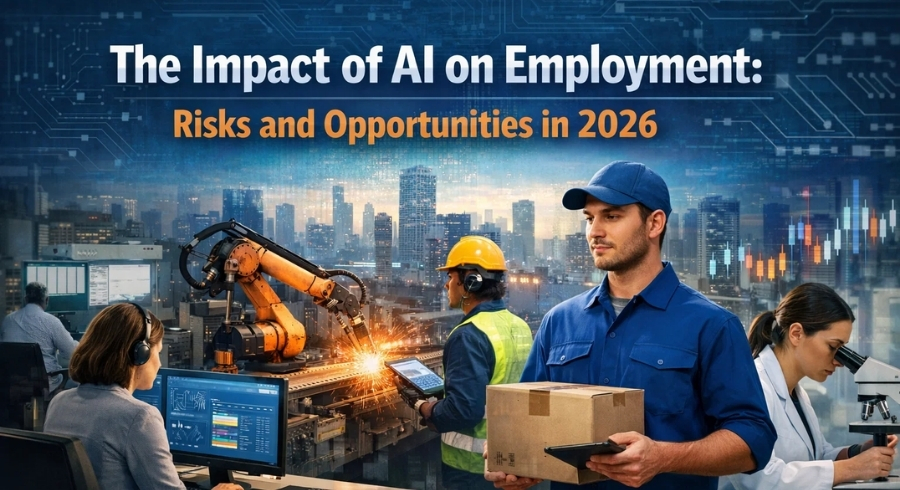
Artificial intelligence is transforming the global workforce in 2026. Discover how AI is influencing job roles, creating new opportunities, widening skill gaps, and reshaping career paths for professionals, businesses, and future MBA graduates navigating the evolving world of work.
Home
›
Jaipuria News
›
The Impact of AI on Employment in 2026: Risks, Opportunities and Skills That Matter
The Impact of AI on Employment in 2026: Risks, Opportunities and Skills That Matter
Published: March 16, 2026,
1:08 pm
| Updated: May 12, 2026
A decade ago, conversations about the impact of AI on employment were largely theoretical. Economists debated projections, technologists made predictions, and most professionals felt the disruption was still some distance away. That distance has now closed entirely.
In 2026, AI is not approaching the workplace. It is already inside it. It is screening candidates before a human recruiter reads a single CV. It is flagging credit risk before a loan officer opens a file. It is routing customer queries, forecasting inventory, and generating first-draft reports. The question of whether AI will influence employment has been answered. The question that now demands attention is how individuals, organisations, and institutions respond to a transformation that shows no sign of slowing.
MBA with Artificial Intelligence (AI)
Across industries, AI systems are automating routine processes, enhancing decision-making speed, and redefining productivity benchmarks. For professionals, students, and business leaders alike, the ability to adapt is no longer optional. It is the defining professional skill of this decade.
Where AI Is Reshaping Roles
AI adoption is most visible in functions built around repetitive and rule-based tasks. Data entry, document verification, invoice processing, customer support, and standardised reporting are increasingly handled by intelligent systems capable of processing large volumes of information quickly and accurately.
This does not mean entire professions are disappearing. Roles are being redesigned. Teams that once focused on manual execution are now expected to supervise automated systems, validate outputs, and concentrate on analysis and strategic interpretation.
The nature of work is shifting from task completion to oversight and value creation.
The Real Risk: Skill Displacement
The more immediate concern is not widespread unemployment but skill mismatch. As AI systems take over structured processes, demand for routine execution decreases while demand for digital fluency and analytical capability rises.
Best MBA Colleges in Delhi NCR
Mid-skill, process-oriented roles face the greatest exposure. Workers who rely solely on repetitive functions without upgrading their capabilities may find fewer long-term opportunities. The pace of change can outstrip the speed at which individuals or organisations invest in reskilling.
This widening skills gap is creating divergence within the labour market, making continuous learning a necessity rather than an advantage.
Where AI Is Creating Opportunity
While AI automates certain tasks, it is also generating new roles and expanding the scope of existing ones.
Organisations are actively recruiting for:
- Prompt Engineers
- AI Trainers and Data Annotators
- Machine Learning Operations (MLOps) Specialists
- AI Ethics and Governance Professionals
Beyond technical positions, there is a rising demand for people who can interpret AI-driven insights and align them with business objectives. Professionals who combine domain expertise with data literacy are increasingly valuable.
What This Means for Businesses
AI adoption is not purely a technological upgrade. It is a strategic and cultural shift.
Organisations must address:
- Transparent communication around automation
- Workforce transition planning
- Reskilling investment
- Ethical use of AI systems
- Maintaining morale during structural change
Companies that treat AI only as a cost-reduction mechanism often encounter long-term cultural challenges. Those that integrate workforce development alongside technology adoption tend to achieve more sustainable results.
The Role of Management Education in an AI-Driven Economy
In an AI-influenced labour market, management education must evolve alongside industry transformation.
Students need:
- Conceptual understanding of AI systems
- Data interpretation and analytical capability
- Strategic decision-making skills
- Ethical awareness in technology deployment
- Cross-functional collaboration abilities
Most management programmes are still catching up to this reality. Jaipuria Institute of Management has moved ahead of it. As India’s first AI-native B-school, Jaipuria has embedded AI across its MBA curriculum, not as an add-on module but as a foundational layer running through how students learn, analyse, and make decisions.
Apply Now for MBA^/PGDM
The result is graduates who are trained not just to understand how AI is reshaping business, but to lead within that reality from day one.
Looking Ahead
The impact of AI on employment will continue to evolve. Some industries will experience displacement in routine roles, while others will see growth in new categories of work. The extent of change will vary across sectors and geographies.
What remains consistent is the importance of preparedness. Professionals who strengthen digital literacy, develop strategic insight, and commit to lifelong learning will remain competitive. Organisations that align technological advancement with human capability development will sustain long-term success and be better positioned to lead through whatever the next wave of change brings.
Frequently Asked Questions
Will AI eliminate most jobs in the next decade?
AI is more likely to transform jobs than eliminate them entirely. While certain tasks will be automated, many roles will evolve to include oversight, analysis, and strategic responsibilities.
Which roles are most vulnerable to AI automation?
Roles centred on predictable, repetitive processes such as data entry, document processing, and basic customer service are most exposed in the near term.
Group Discussion Topics
What new job roles is AI creating?
AI is driving demand for prompt engineers, AI trainers, machine learning operations specialists, data analysts, and governance professionals. Hybrid business roles that combine domain expertise with digital skills are also expanding.
What skills are most important in an AI-driven workforce?
Digital literacy, analytical reasoning, strategic thinking, adaptability, and communication are increasingly valuable. The ability to work alongside AI tools is becoming an essential baseline across most professional roles.
How does AI affect MBA graduates specifically?
MBA graduates are trained to make strategic decisions, interpret data, and lead teams. These capabilities position them to manage AI integration within organisations effectively, making them well-suited to roles that sit at the intersection of technology and business.
Is the skills gap a bigger concern than job displacement?
In many industries, yes. Organisations often adopt AI systems faster than they upgrade workforce capabilities, creating strong demand for digitally fluent professionals who can bridge that gap.
How should companies manage AI-driven workforce transformation?
Companies should prioritise transparent communication, structured reskilling programmes, ethical governance, and long-term capability development alongside automation initiatives.
Which industries are most affected by AI in 2026?
Banking, retail, logistics, manufacturing, and technology services are among the most affected sectors, particularly in process-driven roles.
Can reskilling realistically keep pace with AI adoption?
Reskilling can keep pace if individuals and organisations invest early and align training programmes with evolving industry demand. The gap widens when reskilling is treated as reactive rather than ongoing.
MBA Entrance Exams
How can students prepare for an AI-influenced job market?
Students should build strong foundations in analytics, digital business understanding, and leadership. Choosing a management programme that integrates these elements provides structured preparation for a future-ready career.
Trending AI-based Knowledge Sharing Videos of Jaipuria Institute of Management

Tags
AI and jobsAI and MBA careersAI career opportunitiesAI employment trends 2026AI in business educationAI opportunities in workforceAI skills for MBA graduatesAI skills gapAI workforce transformationartificial intelligence job displacementbusiness schools preparing for AIfuture jobs for MBA studentsfuture of work AIhow AI is changing jobsimpact of AI on employmentJaipuria Institute of Managementmanagement education and AIMBA programs and AI skills