


Artificial intelligence is changing how students learn, study, research, and prepare for careers in ways that are already visible and growing rapidly. This article explores the genuine benefits of AI for students across school, undergraduate, and postgraduate education, covering personalised learning, productivity tools, research assistance, career preparation, and the critical thinking skills that AI cannot …
Home
›
Jaipuria News
›
AI for Students: How Artificial Intelligence Is Transforming Learning in 2026
AI for Students: How Artificial Intelligence Is Transforming Learning in 2026
Published: May 12, 2026,
1:35 pm
| Updated: July 1, 2026
Table of Contents
- Introduction
- Personalised Learning at Every Level
- Access to 24-Hour Intelligent Academic Support
- Accelerated Research and Information Processing
- Writing Quality and Communication Development
- Immersive and Simulation-Based Learning
- Career Preparation and Placement Readiness
- Building Critical AI Literacy
- What AI Cannot Replace in Student Learning
- Conclusion
- Frequently Asked Questions (FAQs)
- Sources
Introduction
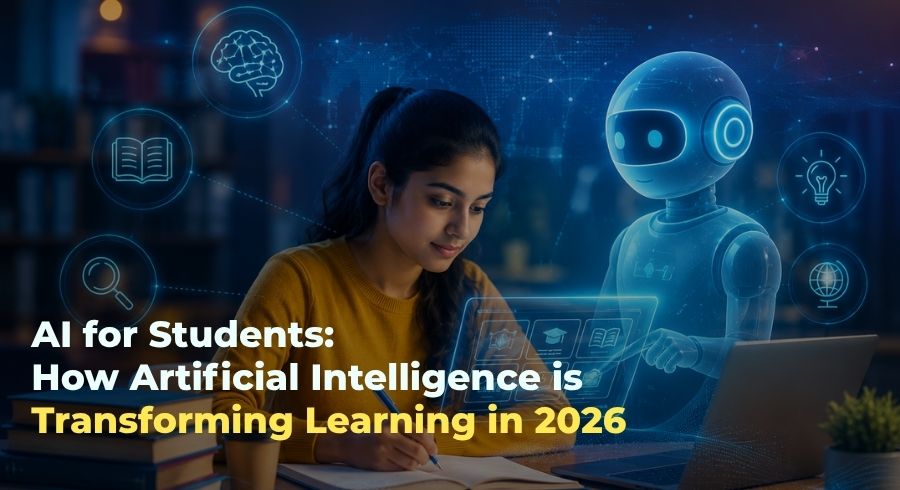
The learning benefits of AI for students are among the most significant and most immediately practical changes in education in a generation. Artificial intelligence is reshaping how students access information, understand complex concepts, practise skills, manage time, and prepare for careers, not as a future possibility but as a present and growing reality that is already differentiating students who engage with it from those who do not.
According to UNESCO, AI has the potential to significantly improve access to quality education and learning outcomes if implemented responsibly, particularly in diverse educational systems like India’s. The World Bank similarly identifies technology-enabled personalised learning as one of the most effective tools for reducing educational inequality at scale. For individual students, however, the most immediate and practical benefits are not structural but personal: AI tools are making it easier to learn more deeply, more efficiently, and more specifically aligned with each student’s individual needs and goals.
This guide examines the genuine benefits of AI for students across educational contexts, with honest attention to both what AI can deliver and what it cannot replace.
Key Takeaways
- AI is transforming how students learn through personalised learning, instant academic support, research assistance, and productivity tools.
- AI-powered tools help students improve writing, interview preparation, analytical thinking, and career readiness in competitive industries.
- The most valuable student skill in 2026 is not just using AI tools, but developing critical AI literacy and problem-solving capability.
- Jaipuria Institute of Management is integrating AI-native education, immersive simulations, and AI-powered placement preparation to build future-ready management professionals.
Personalised Learning at Every Level
The most fundamental limitation of traditional education has always been that classroom instruction is designed around an average student. Teachers set a pace, a level of complexity, and a sequence of content that works reasonably well for the middle of a group but systematically underserves both students who need more time and those ready to move faster. This structural limitation has existed for as long as formal education has.
Artificial intelligence (AI) addresses this limitation directly by analysing each student’s learning behaviour, performance patterns, response times, and error types to build an individual model of where that student is, what they understand, and what they need next. Rather than receiving the same explanation as every other student, regardless of whether it is the right level, a student using an AI learning tool receives content and explanation calibrated specifically to their demonstrated understanding.
According to McKinsey and Company, personalised learning systems supported by AI can improve student outcomes by up to 30 percent compared to standardised instruction. Adaptive learning paths improve performance by adjusting in real time based on student progress, while targeted practice focuses specifically on identified gap areas instead of revisiting already mastered material. Immediate feedback also helps students address errors the moment they occur rather than waiting for weekly or monthly assessments.
Access to 24-Hour Intelligent Academic Support
One of the most practically impactful benefits of AI for students is availability. Academic questions do not arise on a schedule that aligns with office hours, tutorial sessions, or the availability of helpful classmates. They arise at 11 pm before a morning submission, during self-study on a Sunday afternoon, and in the middle of a topic that was not covered adequately in class.
AI-powered tutoring tools, including ChatGPT, Claude, Gemini, and a growing ecosystem of subject-specific learning assistants, provide intelligent and substantive responses to academic queries at any hour. For students in India, where the teacher-to-student ratio in most educational institutions makes individual support structurally difficult to sustain, this represents a meaningful democratisation of access to explanation and guidance.
The OECD mentions that AI-driven tutoring systems significantly improve engagement in self-paced learning environments, where the absence of an available teacher has traditionally been the most significant barrier to continued progress. A student who gets stuck on a valuation concept at midnight can resolve that understanding in minutes with an Artificial Intelligence (AI) tool rather than carrying the confusion into the next day’s class.
Accelerated Research and Information Processing
Research remains one of the most time-intensive components of academic work, but AI tools dramatically reduce the time students need to move from a research question to a structured understanding of relevant literature and evidence.
AI-powered research tools, including Perplexity AI, Claude, and large language models with research capabilities, can identify relevant sources, summarise complex research papers, extract key findings, and generate structured literature overviews in minutes rather than hours. For students working on dissertations, case studies, capstone projects, and research assignments, this compression of the research discovery phase frees time for the higher-value work of analysis, critique, and synthesis.
According to IBM, AI analytics tools can identify patterns across large information datasets that would take humans many times longer to process manually, with the same principle applying to academic literature. A student who would previously spend three hours identifying and reading five relevant papers on a topic can now spend thirty minutes using Artificial Intelligence (AI) to identify the ten most relevant sources, review AI-generated summaries of each, and then invest two hours in critical reading and analysis of the two or three most important ones, producing better work in less time.
This productivity gain is not an excuse to avoid deep engagement with primary sources. It is a tool for using the limited time available more intelligently, spending it on the intellectual work that creates genuine understanding rather than on the mechanical information-gathering that precedes it.
Writing Quality and Communication Development
Writing is a skill that improves through deliberate practice with feedback, and AI tools provide a form of immediate and detailed writing feedback that most educational settings cannot deliver at scale.
Artificial intelligence (AI) writing assistants identify grammatical errors, improve sentence clarity, flag structural inconsistencies, suggest more precise vocabulary, and highlight unclear or underdeveloped arguments. These tools provide real-time feedback as students write rather than after instructors mark a submission, allowing students to make corrections during the drafting process instead of after completing the assessment.
For international students or those from non-English educational backgrounds, AI writing tools act as a particularly significant equaliser. Students with strong analytical thinking but less-developed written English skills can use Artificial Intelligence (AI) assistance to bridge that gap and communicate their ideas with greater clarity.
The critical boundary is that AI writing assistance should improve the expression of the student’s own thinking, not generate thinking that the student has not done. This distinction matters both ethically and practically: the development of clear written communication is a genuine professional skill that management employers test directly, and students who have outsourced this development to AI tools arrive in their first roles with a capability gap that becomes quickly apparent.
At Jaipuria Institute of Management, the mandatory Public Speaking and Persuasion workshop-based course alongside GenAI for Managers creates a curriculum framework that develops both AI tool proficiency and the underlying communication capability that professional life requires. This dual development ensures that AI tools amplify existing communication skills rather than substitute for their development.
Immersive and Simulation-Based Learning
Artificial Intelligence (AI) transforms education most powerfully by creating genuinely immersive learning environments where students practise complex skills in realistic simulated contexts instead of merely reading about them or answering multiple-choice questions.
AI-powered simulations can place students inside realistic business scenarios, ethical dilemmas, crisis management situations, and negotiation contexts where the decisions they make have realistic consequences within the simulation and where they receive immediate feedback on both what they decided and how their decision-making process could be improved.
This learning approach develops the skills that management careers truly demand—decision-making under uncertainty, persuasion and influence, crisis management, and analytical reasoning applied to ambiguous real-world problems—far more effectively than passive instruction.
Jaipuria Institute of Management’s investment in immersive AI-driven simulations directly reflects this evidence. Students can test their critical thinking by engaging in debate with Karl Marx to sharpen analytical argumentation, navigate crisis scenarios through CrYsis to develop self-management and decision-making under pressure, learn strategic persuasion through Propaganda Wars, and develop deduction and analytical reasoning through Christie. These are not supplementary enrichment activities. They are core elements of a learning design philosophy that treats active application as essential rather than optional, and that AI makes possible at a sophistication and scale that manual role-play or case discussion cannot match.
Career Preparation and Placement Readiness
For students in professional education programmes, one of the most immediately valuable applications of Artificial Intelligence (AI) is in career preparation activities: interview practice, CV optimisation, company research, and role alignment.
AI-powered interview simulation tools allow students to practise unlimited mock interviews, receiving structured feedback on their answers, identifying patterns in their weaknesses, and improving their response quality through iteration without the scheduling constraints or social awkwardness that human mock interview partners involve. This dramatically increases the volume of deliberate practice available before the placement season, which directly correlates with placement outcomes.
According to the Confederation of Indian Industry, structured interview preparation is one of the strongest predictors of placement success in campus recruitment processes. AI tools make this preparation accessible at scale and at any time, removing the resource constraint that has historically limited how much individualised preparation students at most institutions can access.
At Jaipuria Institute of Management, the AI-native placement preparation ecosystem specifically addresses this dimension. Rehearsal provides an AI-powered interview simulation with structured response feedback. The Interview Question Assistant generates company-specific and role-specific practice questions. Resume Evaluator analyses CV drafts against target role requirements and suggests specific improvements.
Persona Play helps students understand their managerial archetype, identifying whether they tend towards being Strategists, Innovators, or Executors, and aligning their professional narrative with appropriate career paths. AI-Lingo simplifies complex technical concepts into accessible language, helping students in non-technical backgrounds develop the Artificial Intelligence (AI) literacy that recruiters increasingly expect.
This preparation ecosystem is one of the most practically differentiating aspects of Jaipuria Institute of Management’s student offering, because it directly improves the quality of students’ placement performances in ways that translate into measurable outcomes: 80 plus PPOs in the 2023-25 batch from companies including Deloitte, BNY, Bajaj Allianz, Oxane Partners, and Whirlpool.
Building Critical AI Literacy
Perhaps the most important long-term benefit of effective Artificial Intelligence (AI) integration in education is not any specific productivity gain but the development of genuine and critical AI literacy: the ability to use AI tools effectively, evaluate their outputs critically, understand their limitations honestly, and make informed judgements about when human thinking must override AI recommendations.
This literacy is becoming a baseline professional expectation across management, consulting, analytics, and technology roles. According to NASSCOM, AI literacy is among the three fastest-growing skill requirements across management roles in India. Employers are increasingly distinguishing between candidates who have read about AI and candidates who regularly use it in professional contexts, and who understand enough about how it works to evaluate its outputs critically rather than accepting them uncritically.
Education systems that integrate AI directly into the learning process, rather than teaching it as a separate subject, help students embed critical AI literacy into their professional practice instead of limiting it to theoretical understanding. When students at Jaipuria Institute of Management use AI tools throughout their two-year programme for research, writing, placement preparation, and immersive simulations, they develop a professional, critical, and contextualised relationship with Artificial Intelligence (AI) rather than a casual or uncritical one.
What AI Cannot Replace in Student Learning
Honest guidance about AI for students requires acknowledging its genuine limitations as clearly as its benefits.
AI cannot replace the intellectual development that happens through genuine struggle with difficult ideas. The cognitive effort of working through a problem that resists easy resolution, persisting through confusion, and eventually arriving at understanding is one of the primary mechanisms through which deep learning occurs. Artificial intelligence (AI) that resolves this struggle too quickly, by providing answers before the thinking has been done, can short-circuit the development process rather than supporting it.
AI cannot replicate the relational learning that students gain through peer interaction, mentorship, and collaborative problem-solving in diverse groups. Peers and faculty help students develop self-awareness through feedback, shape their professional identity through immersive experiences, and build meaningful professional networks throughout a management programme—outcomes that AI can support but never replace.
AI can generate text that appears confident and authoritative on almost any topic, but it can also generate factual errors, biased outputs, and plausible-sounding conclusions that are wrong. Students who use Artificial Intelligence (AI) without developing the critical literacy to evaluate its outputs are replacing their own thinking with a more sophisticated but still fallible process.
And AI cannot replace the ethical formation that strong education is designed to produce. Making good judgments in complex situations where the right answer is not obvious, managing competing stakeholder interests fairly, and leading with integrity in circumstances where easier paths exist are capabilities that emerge from values development, not information processing.
Conclusion
Artificial intelligence (AI) provides genuine, substantial, and growing learning benefits for students across educational contexts. Personalised learning pathways, 24-hour intelligent academic support, accelerated research, writing quality improvement, immersive simulation-based practice, and AI-powered career preparation are all delivering measurable improvements in learning outcomes and professional readiness.
The students who benefit most from these tools are those who use them to amplify their own thinking, accelerate their own learning, and practise their own skills more intensively, rather than those who use them as a substitute for the intellectual effort that genuine education requires.
The institutions that serve their students best in this environment are those that have integrated AI thoughtfully into the learning design rather than bolted it on as an afterthought. Jaipuria Institute of Management’s AI-native approach, immersive simulations, AI-powered placement tools, and the Campus Intelligence assistant represent the direction that strong management education is moving. Students who engage with this ecosystem emerge with both the Artificial Intelligence (AI) proficiency that employers expect and the underlying analytical, ethical, and communication capabilities that sustain a career.
Frequently Asked Questions (FAQs)
How is AI changing learning for students?
AI is enabling personalised learning at scale, providing 24-hour intelligent academic support, accelerating research, improving writing quality through real-time feedback, and offering immersive simulation-based practice for complex professional skills.
What AI tools are most useful for students?
ChatGPT and Claude for research and writing, Perplexity AI for research discovery, Grammarly for editing, Microsoft Copilot for Office productivity are among the most widely used and practically beneficial.
Does AI improve academic performance?
Research from McKinsey and Company indicates that AI-supported personalised learning can improve student outcomes by up to 30 percent compared to standardised instruction. The benefit is strongest when Artificial Intelligence (AI) is used to support rather than replace genuine learning effort.
Is using AI for assignments ethical?
It depends on the specific assessment and institutional policy. Using AI to improve clarity, check grammar, or generate practice problems is generally acceptable. Using Artificial Intelligence (AI) to generate assessed content you have not thought through yourself raises academic integrity concerns.
How does Jaipuria Institute of Management use AI in student learning?
Through immersive simulations including CrYsis, Christie, and Propaganda Wars, AI-powered placement tools including Rehearsal and the Interview Question Assistant, AI-Lingo for technical concept simplification, and the Campus Intelligence assistant for academic navigation.
Can AI replace teachers or professors?
No. AI can support, extend, and personalise instruction, but it cannot replicate the mentorship, intellectual challenge, ethical modelling, and relational learning that effective educators provide.
Does AI make students lazy?
It can, if used without discipline or critical engagement. Students who use AI to avoid thinking rather than to amplify it are undermining their own development. The responsibility for using Artificial Intelligence (AI) well lies with the student.
What is AI literacy, and why does it matter for students?
AI literacy is the ability to use AI tools effectively, evaluate their outputs critically, and understand their limitations. It is becoming a baseline professional expectation. NASSCOM identifies it as among the fastest-growing skill requirements across management roles in India.
Which educational institutions are leading in AI integration for students?
Institutions that embed Artificial Intelligence (AI) throughout the learning experience rather than offering it as a single elective are leading this transition. Jaipuria Institute of Management’s AI-native design, with a mandatory AI curriculum, AI-powered simulations, and an integrated placement preparation ecosystem, represents one of the more comprehensive approaches in Indian management education.
Sources
- The Impact of Education on Human Development in the 21st Century: Needs, Challenges& Opportunities
- How artificial intelligence will impact K-12 teachers
- OECD Digital Education Outlook
- Rehearsal AI
Trending AI-based Knowledge Sharing Videos of Jaipuria Institute of Management

Prem Pandey
Prem Pandey is a Digital Marketing Manager with over 20 years of experience in SEO, content marketing, lead generation, brand building, and digital growth strategies. He specializes in driving online visibility, optimizing digital campaigns, and leveraging data-driven and AI-powered marketing solutions to enhance audience engagement and business performance.
Tags
AI benefits for students IndiaAI for StudentsAI for students learning benefitsAI in educationAI in education benefits IndiaAI personalised learning studentsAI student productivity IndiaAI tools for students 2026artificial intelligence in education studentshow AI helps students learnhow AI improves student outcomesJaipuria AI learning ecosystemJaipuria AI tools studentsJaipuria AI-native educationJaipuria GenAI for ManagersJaipuria Institute of Management