


The MBA placement landscape in India today looks meaningfully different from five years ago. Two forces have driven this transformation more than any others: the disruption caused by the COVID-19 pandemic and the rapid rise of artificial intelligence. Understanding how these two forces have combined to produce the current placement environment is an essential context …
MBA Placement Trends After COVID and AI Era
Published: April 24, 2026,
12:15 pm
| Updated: June 1, 2026
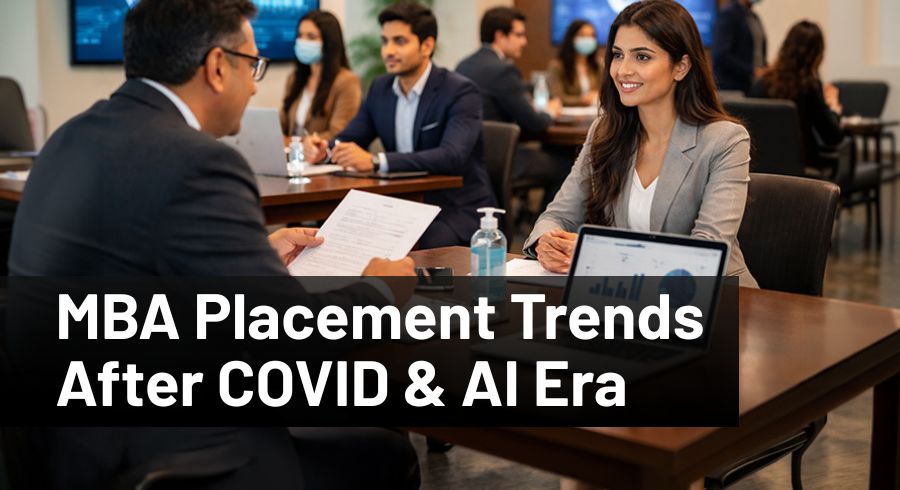
The MBA placement ecosystem in India today looks meaningfully different from what it was five years ago. Two forces have driven this transformation more than any others: the disruption caused by the COVID-19 pandemic and the rapid, accelerating rise of artificial intelligence as a business tool.
Understanding how these forces have reshaped hiring patterns, recruiter expectations, and career outcomes is not simply historically interesting. It is practically essential for MBA aspirants planning their careers in 2026 and beyond. The students who will do best in this environment are those who understand what has changed, what has remained constant, and how to position themselves accordingly.
According to the World Economic Forum’s Future of Jobs Report, nearly 44 percent of core skills required for jobs are expected to change by 2027, with analytical thinking and AI literacy emerging as the most critical capabilities across a wide range of roles. This shift is already clearly visible in MBA placement outcomes across India, where the premium commanded by graduates with genuine analytical capability is growing and the gap between well-prepared and underprepared candidates is widening.
Institutions like Jaipuria Institute of Management have responded to this environment by embedding AI, analytics, and structured placement preparation into their programmes across all four campuses in Lucknow, Noida, Jaipur, and Indore, building what the institute describes as an AI-native learning and career development ecosystem.
Apply Now for MBA^/PGDM
How COVID Reshaped MBA Placements
The immediate impact of the pandemic on MBA placements during 2020 and 2021 was severe. Campus hiring slowed dramatically, offers were deferred, and uncertainty dominated recruiter behaviour as companies across industries reassessed their near-term hiring needs. For MBA graduates entering the job market at the height of the disruption, the experience was considerably more challenging than for any cohort in the preceding decade.
However, the recovery was both rapid and instructive.
Reports from NASSCOM indicate that technology, e-commerce, and fintech sectors saw double-digit growth in hiring between 2022 and 2024, significantly increasing demand for MBA graduates with digital literacy and analytical capability in these domains. Companies that had been forced to accelerate their digital transformation during the pandemic emerged with stronger appetites for managers who could operate effectively in data-driven, technology-enabled environments.
Hybrid Hiring Models
Virtual interviews, online assessments, and remote onboarding are now standard practice across most major recruiters, including those that continue to conduct campus placements. Even companies that prefer face-to-face engagement in the later stages of their recruitment processes have retained virtual elements in earlier rounds for reasons of efficiency and scale. MBA graduates need to be as comfortable and effective in virtual assessment environments as in traditional ones.
Earlier Hiring Cycles
Companies are now engaging with MBA students significantly earlier than they did before the pandemic. Pre-placement talks, live projects, and early talent identification exercises have become standard in the first semester of many MBA programmes. This earlier engagement creates advantages for students who are prepared to make positive impressions from the beginning of their studies rather than only during the formal placement season.
Internship-Centric Hiring
Perhaps the most significant structural shift of the post-pandemic period is the increased centrality of internships to the hiring process. Companies that previously hired primarily through campus placement interviews have increasingly shifted towards using internship performance as the primary basis for hiring decisions. The pre-placement offer has become a much more important pathway to full-time employment than it was before 2020.
At Jaipuria Institute of Management, this shift is reflected directly in placement outcomes. The 2023-2025 batch recorded more than 80 pre-placement offers from companies including Deloitte, BNY, Bajaj Allianz, Oxane Partners, and Whirlpool. These figures reflect both the quality of students the institution produces and the depth of the corporate relationships it has built through sustained recruiter engagement across its four campuses.
How AI Has Changed Recruiter Expectations
If COVID changed how hiring happens, the rise of AI has changed who gets hired and what capabilities command a premium.
The LinkedIn Jobs on the Rise India Report identifies AI literacy, data analysis, and strategic thinking as the fastest-growing skills across management roles. This is not a prediction about future demand. It is a description of what recruiters are currently looking for and frequently failing to find in sufficient supply.
The practical implications of this shift extend across every functional area of business management. Marketing roles now demand proficiency in performance analytics and campaign measurement. Finance roles require familiarity with data modelling and quantitative risk assessment. Human resources is increasingly using predictive analytics for talent acquisition and workforce planning. Operations depends on AI-driven demand forecasting and supply chain optimisation. Even general management roles are more frequently assessing candidates’ comfort with data-driven decision-making frameworks.
The result is that generalist MBA graduates without demonstrated analytical capability are losing competitive advantage in the placement market.
Emerging MBA Placement Roles in the AI Era
AI Strategy and Digital Transformation
Companies across industries are hiring managers who can bridge the gap between AI capabilities and business objectives.
Data and Business Analytics
Business analytics roles are now increasingly accessible to MBA graduates with quantitative skills and business orientation.
Product Management
Product management has become one of the fastest-growing and highest-paying role categories for MBA graduates.
Jaipuria’s Approach to AI-Era Placements
Jaipuria Institute of Management has built its placement ecosystem in direct response to the evolving demands of the post-COVID, AI-driven hiring environment.
The core curriculum includes GenAI for Managers as a mandatory subject. The Business Analytics specialisation includes courses in Python, Machine Learning, AI, Data Visualisation, and Digital Transformation.
The placement preparation ecosystem includes AI-powered tools such as Rehearsal, Resume Evaluator, Interview Question Assistant, AI-Lingo, and Persona Play.
The 2024-26 batch received over 600 placement offers across more than 275 recruiters, with a highest CTC of 24.1 LPA and international offers up to 36.6 LPA.
What Has Not Changed in MBA Placements
Despite structural changes, some fundamentals remain constant:
- Strong communication skills
- Leadership potential
- Team collaboration
- Structured thinking
These must now be combined with analytical and technological capability.
Frequently Asked Questions
How did COVID permanently change MBA placements in India?
It established hybrid hiring models, moved recruitment cycles earlier in the MBA programme, and significantly increased the role of internship-based hiring through pre-placement offers as the primary pathway to full-time employment.
Which sectors grew fastest after COVID for MBA hiring?
Technology, e-commerce, fintech, and consulting saw the fastest recovery and expansion, alongside growth in analytics-focused roles across BFSI and FMCG.
How has AI changed MBA hiring trends?
AI has made data literacy, analytical capability, and technology-enabled decision-making essential skills across management roles.
Are new job roles emerging for MBA graduates?
Yes. Roles in AI strategy, digital transformation, product management, and business analytics have grown significantly.
Is the MBA job market more competitive now?
Yes. Hiring is more selective and more explicitly skill-based than before.
Has the importance of internships increased?
Yes significantly. Pre-placement offers have become a major pathway to final placements.
Which MBA specialisations are most in demand now?
Business Analytics, Finance with data skills, and Marketing with digital analytics are leading.
How should students prepare for placements in the AI era?
Focus on analytical capability, AI tools, internships, and communication skills.
Will MBA placements continue to grow in India?
Yes. Demand for skilled professionals in AI, consulting, and analytics will remain strong.
Trending Placement Videos of Jaipuria Institute of Management

Sumit Pandey
Sumit Pandey is a Web Developer and technical content professional with expertise in modern web design, landing page development, responsive UI design, and content-driven digital experiences. Skilled in creating engaging websites and clear, research-driven technical content focused on performance, creativity, and user experience.
Tags
AI era MBA hiringAI impact MBA placementsJaipuria AI curriculumJaipuria campus recruitment IndiaJaipuria Institute of ManagementJaipuria MBA placementsJaipuria PGDMJaipuria placement trendsmanagement hiring IndiaMBA career trendsMBA job marketMBA placement trendsMBA Placement Trends in AI EraMBA placement trends Indiaplacement changes MBAPlacement in AI Era in Indiapost COVID MBA placements