


Artificial Intelligence is reshaping industries and society, but concerns around privacy, bias, misinformation, transparency, and job displacement continue to grow. This article explores major AI risks, ethical challenges, responsible AI practices, global regulations, and how Jaipuria Institute of Management integrates AI ethics, analytics, and responsible leadership into future-focused management education.
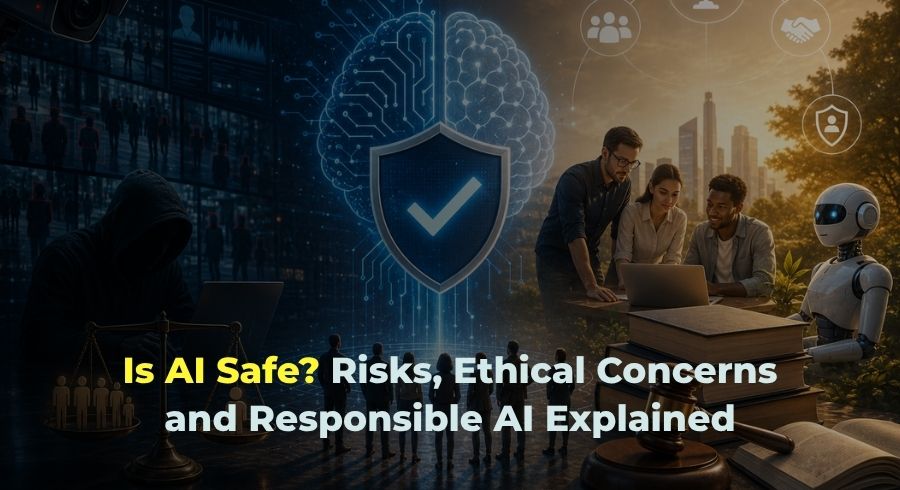
Is AI Safe? Risks, Ethical Concerns and the Future of Responsible AI
Published: June 4, 2026,
1:27 pm
| Updated: June 4, 2026
Table of Contents
- Introduction
- Why AI Is Growing So Rapidly
- Is AI Completely Safe?
- Major Risks of Artificial Intelligence
- Ethical Concerns Around AI
- AI and Data Privacy Issues
- AI and Cybersecurity Threats
- Impact of AI on Jobs and Society
- Global AI Regulations and Governance
- What Is Responsible AI?
- Role of Management Education in Responsible AI
- Future of Safe and Ethical AI
- Final Thoughts
- Frequently Asked Questions
- Sources
Introduction
Artificial Intelligence is now deeply integrated into everyday life. From recommendation engines and virtual assistants to fraud detection systems and generative AI tools, AI technologies are transforming how individuals, businesses, and governments operate.
The rapid adoption of AI has also raised an important question:
Is AI safe?
The answer is not straightforward.
AI offers enormous benefits in productivity, automation, healthcare, education, analytics, and business efficiency. At the same time, it creates serious concerns around misinformation, data privacy, algorithmic bias, cybersecurity, and ethical accountability.
As AI adoption accelerates globally, the focus is shifting from simply building AI systems to building safe, transparent, and responsible AI systems.
Key Takeaways
- Artificial Intelligence is improving productivity, automation, healthcare, education, and business decision-making globally.
- AI also introduces major risks related to privacy, misinformation, bias, cybersecurity, and job displacement.
- Responsible AI development requires transparency, regulation, accountability, and ethical governance.
- Governments and institutions worldwide are developing AI safety frameworks and regulatory systems.
- Business schools such as Jaipuria Institute of Management are integrating AI ethics, analytics, and responsible leadership into management education to prepare future-ready professionals.
Why AI Is Growing So Rapidly
AI adoption is increasing because modern AI systems can process and analyse massive volumes of data faster than humans.
AI is currently being used for:
- Customer support automation
- Personalised recommendations
- Financial fraud detection
- Healthcare diagnostics
- Supply chain optimisation
- Predictive analytics
- Content generation
- Business decision-making
Generative AI tools such as ChatGPT, Gemini, and Microsoft Copilot have accelerated AI adoption across industries by simplifying interaction through natural language interfaces.
According to the OECD AI Principles, AI technologies can significantly improve productivity, innovation, and economic growth when implemented responsibly.
Is AI Completely Safe?
No technology is completely risk-free, and AI is no exception.
AI systems depend heavily on:
- The quality of training data
- Human oversight
- Security safeguards
- Ethical design principles
- Regulatory governance
If these systems are poorly designed or irresponsibly deployed, they can create harmful outcomes at scale.
The biggest concern today is not fictional “superintelligent robots” but rather the real-world misuse of AI systems in areas such as misinformation, surveillance, discrimination, and cybercrime.
Major Risks of Artificial Intelligence
1. Bias and Discrimination
AI systems learn from historical data.
If the underlying data contains bias, AI models may reproduce or amplify that bias.
This can affect areas such as:
- Hiring decisions
- Loan approvals
- Facial recognition
- Insurance evaluation
- Predictive policing
Bias in AI systems can create unfair outcomes for individuals and groups.
The NIST AI Risk Management Framework specifically highlights fairness, accountability, transparency, and bias mitigation as critical elements of trustworthy AI systems.
2. Misinformation and Deepfakes
Generative AI tools can now create highly realistic:
- Videos
- Images
- Audio recordings
- News articles
- Social media content
This has increased concerns around:
- Political misinformation
- Identity fraud
- Financial scams
- Fake media manipulation
Deepfake technology is becoming one of the most serious AI-related risks globally because realistic synthetic content can spread rapidly online.
3. Data Privacy Risks
AI systems require enormous amounts of data to function effectively.
This creates several privacy concerns:
| Privacy Risk | Impact |
| Excessive Data Collection | Users may lose control over personal information |
| Weak Consent Mechanisms | Data may be collected without full awareness |
| Cross-Border Data Transfers | Sensitive information may move globally |
| Data Breaches | AI systems may expose confidential information |
| Behavioural Tracking | Continuous monitoring raises surveillance concerns |
As AI adoption grows, protecting user privacy is becoming increasingly important for governments and businesses.
4. Job Displacement and Workforce Disruption
AI automation is changing workforce structures across industries.
Routine and repetitive tasks are increasingly automated in sectors such as:
| Industry | AI Impact |
| Banking | Automated fraud monitoring and processing |
| Customer Service | AI chatbots are replacing repetitive support tasks |
| Manufacturing | Robotics and smart automation |
| Marketing | AI-generated campaigns and content |
| HR | Automated resume screening |
At the same time, AI is also creating new roles in:
- Analytics
- AI governance
- Data management
- Product management
- AI strategy
- Cybersecurity
The future workforce will increasingly require analytical thinking, adaptability, and AI literacy.
5. Cybersecurity Risks
AI can improve cybersecurity systems, but it can also empower cybercriminals.
AI-powered attacks may include:
- Automated phishing emails
- AI-generated scams
- Password cracking
- Deepfake impersonation
- Malware automation
Recent cybersecurity discussions increasingly focus on “AI exposure gaps,” where organisations adopt AI faster than they can secure it.
This is why businesses are investing heavily in AI governance and AI security frameworks.
Ethical Concerns Around AI
AI ethics focuses on ensuring that AI systems remain aligned with human values and societal interests.
The major ethical concerns include:
Transparency
Can people understand how AI systems make decisions?
Accountability
Who is responsible if an AI system causes harm?
Fairness
Does the AI system treat users equally?
Human Oversight
Should humans remain involved in high-risk decisions?
Privacy Protection
Are organisations using personal data responsibly?
The OECD AI Principles emphasise that trustworthy AI should respect human rights, democratic values, fairness, and transparency.
AI and Data Privacy Issues
AI systems depend on large-scale data collection and behavioural analysis.
This creates multiple privacy challenges:
Large Data Dependency
AI models require massive datasets for training and improvement.
Sensitive Information Exposure
Poorly governed AI systems may expose confidential user data.
Weak User Awareness
Many users do not fully understand how AI platforms collect and process data.
Surveillance Concerns
AI-enabled tracking systems can create continuous monitoring environments.
As privacy regulations strengthen globally, organisations are being forced to adopt stricter data governance systems.
AI and Cybersecurity Threats
Cybersecurity has become one of the most critical AI risk areas.
AI strengthens security through:
- Threat detection
- Fraud analytics
- Behaviour monitoring
- Predictive risk assessment
However, attackers are also using AI to create more advanced cyber threats.
The NIST AI RMF highlights the importance of building secure, resilient, explainable, and privacy-enhanced AI systems.
Impact of AI on Jobs and Society
AI is changing the nature of work rather than eliminating all jobs.
Professionals who combine technical understanding with strategic decision-making will remain highly valuable.
Key future skills include:
- AI literacy
- Data interpretation
- Strategic thinking
- Problem-solving
- Communication
- Ethical decision-making
This is why management education is increasingly evolving toward AI-integrated learning.
Institutions such as Jaipuria Institute of Management are integrating AI, analytics, and digital decision-making into management education to prepare students for AI-driven industries.
The focus is not only on learning AI tools but also on understanding responsible AI leadership and the ethical adoption of technology.
Global AI Regulations and Governance
Governments worldwide are actively developing AI governance frameworks.
Major regulatory priorities include:
| Governance Area | Objective |
| Transparency | Explain AI decision-making |
| Bias Monitoring | Reduce discrimination |
| Privacy Protection | Protect user data |
| Risk Classification | Identify high-risk AI systems |
| Human Oversight | Maintain accountability |
The OECD AI Principles and the NIST AI Risk Management Framework are among the most widely referenced global AI governance models today.
These frameworks promote:
- Human-centric AI
- Trustworthy AI systems
- Secure AI deployment
- Responsible innovation
What Is Responsible AI?
Responsible AI refers to the development and deployment of AI systems ethically, securely, and transparently.
Core principles include:
- Fairness
- Transparency
- Accountability
- Privacy protection
- Security
- Human oversight
Responsible AI is becoming a business necessity because organisations face growing legal, operational, and reputational risks from unethical AI usage.
Role of Management Education in Responsible AI
As AI transforms industries, business schools are also evolving rapidly.
Modern management graduates are increasingly expected to understand:
- AI-driven business strategy
- Data analytics
- AI ethics
- Digital transformation
- Technology governance
Institutions such as Jaipuria Institute of Management are integrating analytics, AI-enabled learning tools, and industry-focused curriculum into management education to prepare students for technology-led business environments.
This combination of management capability and AI awareness is becoming highly valuable across consulting, finance, marketing, analytics, operations, and product management roles.
Future of Safe and Ethical AI
The future of AI will depend heavily on governance, regulation, and responsible implementation.
Expected developments include:
- Stronger global AI regulations
- AI transparency standards
- Ethical AI audits
- AI risk governance frameworks
- Human-supervised AI systems
- Improved cybersecurity protections
The long-term objective is not to slow innovation, but to ensure AI remains safe, trustworthy, and beneficial to society.
Final Thoughts
Artificial Intelligence is one of the most transformative technologies of the modern era. It is improving productivity, automation, healthcare, education, and business decision-making at an unprecedented scale.
However, AI also introduces significant risks related to privacy, misinformation, cybersecurity, bias, and ethical accountability.
The future will belong to organisations and professionals who can balance innovation with responsibility.
Understanding AI alone is no longer enough. Understanding responsible AI is now equally important.
Frequently Asked Questions (FAQs)
Is AI completely safe?
No. AI systems carry risks related to privacy, misinformation, cybersecurity, and biased decision-making if not properly governed.
What are the biggest risks of AI?
Major risks include deepfakes, data privacy violations, cyberattacks, algorithmic bias, and workforce disruption.
Can AI invade privacy?
Yes. AI systems often rely on large-scale data collection and behavioural analysis, which can create surveillance and privacy concerns.
What is responsible AI?
Responsible AI refers to the ethical, transparent, secure, and fair design and deployment of AI systems.
Why is AI ethics important?
AI ethics helps ensure AI systems remain accountable, fair, and aligned with human values.
Can AI replace human jobs?
AI can automate repetitive tasks, but it also creates new opportunities in analytics, AI governance, cybersecurity, and strategy.
How are governments regulating AI?
Governments are developing frameworks focused on transparency, fairness, accountability, and privacy protection.
Which industries are most affected by AI?
Technology, banking, healthcare, manufacturing, consulting, retail, and education are among the most affected sectors.
How does Jaipuria Institute of Management prepare students for AI-driven industries?
Jaipuria Institute of Management integrates AI, analytics, and industry-focused learning into its curriculum to help students build future-ready management capabilities.
Sources
- NIST AI Risk Management Framework
- OECD AI Principles
- World Economic Forum – Future of Jobs Report
- IBM – What is Responsible AI?
- McKinsey – The State of AI
- European Commission – Artificial Intelligence Act
Trending AI-based Knowledge Sharing Videos of Jaipuria Institute of Management

Sumit Pandey
Sumit Pandey is a Web Developer and technical content professional with expertise in modern web design, landing page development, responsive UI design, and content-driven digital experiences. Skilled in creating engaging websites and clear, research-driven technical content focused on performance, creativity, and user experience.
Tags
AI and Cybersecurity ThreatsAI and data privacy issuesAI biasAI ethical concernsAI Impact on JobsAI Impact on SocietyAI Is GrowingAI misinformationAI privacy risksAI risksAI safety concernsdangers of AIData Privacy Issuesethical AIEthical AI Futurefuture of AI safetyGlobal AI GovernanceGlobal AI Regulationsis AI EthicalIs AI safeManagement Education in Responsible AIresponsible AIResponsible AI FutureRisks of AIRisks of Artificial IntelligenceWhat Is Responsible AIWhy AI Is Growing So Rapidly