



Understand the meaning of LLMs, Transformer architecture, tokens, self-attention, pretraining and fine-tuning. Discover popular LLMs like GPT, Gemini, Claude and Llama, their business applications, and how LLMs differ from Generative AI and SLMs.
What Is an LLM? Meaning, Examples, Applications and How It Works
Published: November 17, 2026,
5:03 pm
| Updated: November 17, 2026
Table of Contents
- Introduction
- What Is an LLM?
- How Is an LLM Different from Traditional AI?
- Key Terms Explained
- How Does an LLM Work? Step by Step
- What Are the Different Types of LLMs?
- Popular LLM Examples
- Applications of LLMs Across Business Functions
- Limitations of Large Language Models
- Why Do Prompts Matter for LLMs?
- Why Understanding LLMs Matters
- Frequently Asked Questions (FAQs)
- Sources
Introduction
ChatGPT, Gemini and Claude can write emails, explain concepts, debug code, analyse information and perform several other tasks. These AI tools are powered by large language models, or LLMs, which enable them to process user instructions and generate relevant responses.
Apply Now for MBA^/PGDM
PGDM Entrance Exams 2026-27
But what exactly are LLMs, and what makes them capable of performing such a wide range of tasks? This guide explores the meaning of LLMs, popular examples, business applications and the limitations users should understand.
Key Takeaways
- LLM stands for Large Language Model, a deep learning model trained on extensive datasets to process and generate language.
- Most modern LLMs use Transformer architecture and attention mechanisms to understand relationships between tokens.
- Popular LLM families include GPT by OpenAI, Gemini by Google, Claude by Anthropic, Llama by Meta and DeepSeek.
- LLMs power a wide range of applications, from generating and summarising content to assisting with coding, translation, research and business decision-making.
- LLMs can produce inaccurate or biased responses, making human verification important.
- Clear prompts, relevant context and specific instructions can improve the quality of LLM-generated responses.
What Is an LLM?
An LLM is a large language model. IBM defines LLMs as “a category of deep learning models trained on immense amounts of data” that can understand and generate natural language and other content for a wide range of tasks. [1]
Google’s Machine Learning Crash Course puts it more simply. LLMs “predict a token or sequence of tokens, sometimes many paragraphs worth of predicted tokens,” and are essentially autocomplete systems operating at a much larger scale. [2]
The three words in Large Language Model explain its basic characteristics:
- Large: LLMs are trained on extensive datasets and can contain billions of parameters.
- Language: They process human language and, depending on the model, can also work with programming languages and other forms of information.
- Model: They are mathematical systems that learn patterns and relationships from training data.
How Is an LLM Different from Traditional AI?
Traditional AI systems are designed to perform specific tasks using predefined rules or specialised models. For example, a conventional spam filter identifies unwanted emails based on learned patterns, and a credit-scoring tool evaluates risk using fixed financial formulas. Because they rely on structured rules and narrow training, these systems excel at predictable tasks like sorting data, detecting fraud, or forecasting numbers.
An LLM, on the other hand, can perform many different language-related tasks using the same underlying model. Trained on vast amounts of text, it generates new, human-like responses based on the instructions or prompts it receives. Instead of needing a separate program for each job, a single LLM can draft an email, explain a financial concept, translate a paragraph, or summarise a report.
MBA Entrance Exams 2026-27
Group Discussion Topics for Management Students
This flexibility makes LLMs useful across different industries and everyday applications, while traditional AI remains essential for high-precision, rule-bound tasks.
Key Terms Explained
| Term | Plain-language meaning |
|---|---|
| Token | A unit of text, such as a word, subword, or single character [2] |
| Parameter | A weight the model learns during training; some LLMs have billions of parameters [1] |
| Transformer | A neural network architecture used by most modern LLMs [2] |
| Self-attention | A mechanism that determines how much each token influences the meaning of another token [2] |
| Prompt | The input you give the model to elicit a response [3] |
| Pretraining | The initial training process through which a model learns patterns from large datasets |
| Fine-tuning | Further training that adapts a pretrained model for specific tasks or behaviours |
| Inference | The process of generating an output after receiving an input |
| Context window | The amount of information a model can process within a given interaction |
| RAG | Retrieval-Augmented Generation, a technique that supplies relevant external information to an LLM |
These concepts form the foundation of LLM architecture, training and everyday applications.
How Does an LLM Work? Step by Step
Step 1: Text Is Divided into Tokens
Before processing text, an LLM uses a process called tokenisation.
Instead of treating an entire sentence as one unit, the model divides it into smaller pieces called tokens. A token can represent a complete word, part of a word, punctuation mark, or character.
For example, the sentence “Artificial intelligence is changing business” may be divided into several tokens.
Tokenisation allows the model to represent language numerically so that its neural network can process it.
Step 2: Pretraining
Pretraining is the initial stage of LLM development.
During this stage, the model learns from extensive datasets containing text from books, websites, articles, code and other sources. It identifies patterns in language, grammar, sentence structures and relationships between words.
Many LLMs use self-supervised learning, where the model learns by predicting missing or subsequent tokens from the available data.
Through repeated training, the model develops the ability to recognise language patterns and generate contextually relevant sequences.
Step 3: Transformer Architecture and Self-Attention
Most modern LLMs use the Transformer architecture, introduced in 2017. It helps models understand text by identifying relationships between words.
One of its key components is self-attention, which helps the model determine which words are important for understanding a sentence.
Example: In the sentence, “The dog chased the ball because it was moving,” self-attention helps the model understand that “it” refers to “the ball” rather than “the dog.”
This mechanism helps LLMs understand context, process longer sentences and generate more relevant, coherent responses.
Best MBA College in Delhi NCR
Top 10 Management Institutes in Noida (Delhi NCR)
Step 4: Model Scaling
Another important development in LLMs has been increasing the scale of training data, model parameters and computational resources.
In 2020, OpenAI introduced GPT-3, an autoregressive language model with 175 billion parameters. [4]
Its research demonstrated how increasing model scale could improve performance across different language tasks, including those for which the model had not received specific training examples.
However, a larger model does not automatically perform better at every task. Performance also depends on training quality, architecture, data and model evaluation.
Step 5: Fine-Tuning and Alignment
After pretraining, an LLM may undergo additional training to improve its ability to follow instructions and respond appropriately.
Common approaches include:
- Supervised Fine-Tuning: The model is trained on examples of instructions and desirable responses.
- Instruction Tuning: The model learns to follow different types of user instructions.
- Reinforcement Learning from Human Feedback (RLHF): Human preferences are used to help improve the quality and helpfulness of responses.
- Domain-Specific Fine-Tuning: The model is further adapted for specialised areas such as finance, healthcare, legal research or customer support.
These methods help make pretrained models more useful for practical applications.
Step 6: Inference and Response Generation
Inference is the process through which an LLM generates an answer after receiving a prompt.
When a user enters a question, the model processes the input, analyses the available context and predicts the next token. It continues generating tokens until it completes the response or reaches a stopping condition.
For example, when someone asks, “Explain artificial intelligence in simple words”, the model generates a sequence of tokens that forms an appropriate explanation.
Some applications also use Retrieval-Augmented Generation (RAG). This approach retrieves relevant information from an external knowledge source and supplies it to the model to help generate a more grounded response.
This is particularly useful when an application needs information from specific documents, databases or updated knowledge sources.
Best MBA College in Lucknow
Top Management Institutes in Jaipur
What Are the Different Types of LLMs?
Large Language Models can be classified according to their architecture, training approach, accessibility and intended applications.
Some common categories include:
-
Autoregressive Language Models
These models generate text by predicting the next token based on previously generated tokens. They are commonly used for conversational AI, content generation and code completion.
-
Encoder-Based Language Models
These models are designed to understand and represent text rather than generate long sequences of new content. They are commonly used for classification, information extraction and sentiment analysis.
-
Encoder-Decoder Models
These models combine an encoder that processes input information with a decoder that generates output. They are useful for tasks such as translation, summarisation and text transformation.
-
Open-Weight and Proprietary LLMs
LLMs can also be classified by how their underlying model weights are made available.
- Open-weight models make their trained weights available for external use, subject to their respective licences.
- Proprietary models are generally accessed through services or APIs controlled by their developers.
This distinction is important for organisations choosing models based on customisation, data control, infrastructure and deployment requirements.
Popular LLM Examples
Some popular examples of Large Language Models (LLMs) include GPT by OpenAI, Gemini by Google, Claude by Anthropic, Llama by Meta and DeepSeek.
Applications of LLMs Across Business Functions
Large Language Models (LLMs) are used across virtually every industry because they can read, analyse, and generate human-like text at scale. By automating routine communication and information processing, they help teams save time and focus on higher-value work.
Best Management Institutes in Noida
Top MBA Colleges in Indore
Here are some of the most common business use cases:
- Customer Support
LLMs power conversational chatbots and virtual assistants that answer customer questions, troubleshoot common issues, and route complex tickets to human agents 24/7. - Marketing
Marketing teams can use LLMs to brainstorm campaign ideas, draft blog posts, write product descriptions, and adapt messaging for different audiences and platforms. - Sales and Business Development
LLMs help sales representatives research prospects, draft personalised outreach emails, summarise call notes, and update customer relationship management (CRM) records. - Software Development and IT
Developers can use LLMs to write boilerplate code, debug errors, explain unfamiliar codebases, and generate technical documentation. - Human Resources and Recruiting
HR teams rely on LLMs to write job descriptions, screen candidate resumes, draft interview questions, and answer employee policy questions. - Legal and Compliance
LLMs assist legal teams by summarising lengthy contracts, flagging non-standard clauses, and searching through regulatory documents for specific rules. - Finance and Operations
Analysts can use LLMs to summarise earnings reports, extract key figures from invoices, and draft internal performance briefings.
Limitations of Large Language Models (LLMs)
Despite their capabilities, LLMs have limitations that users and organisations must understand before relying on their outputs.
Some of the most common challenges include:
- Hallucinations
LLMs can generate information that is false, misleading or unsupported while presenting it confidently. These errors are commonly called AI hallucinations.
- Bias
Models can reflect biases present in their training data. This can affect the language, recommendations and information they generate.
- Outdated Information
An LLM may not have access to the latest information. Its knowledge can be limited by its training data, unless it is connected to external sources or retrieval systems.
- Data Privacy and Security
Sharing confidential business information or personal data with an AI service can create privacy and security risks. Organisations should follow appropriate data protection policies and understand how their chosen tools handle information.
- Computational Requirements
Training and operating large models can require substantial computing resources, energy and infrastructure.
- Limited Context and Reliability
Even models with large context windows can overlook information, misunderstand complex instructions or produce inconsistent answers.
These limitations highlight the importance of human judgement and verification. An LLM can assist with analysis and productivity, but its outputs should not automatically be treated as verified facts.
Apply Now for MBA^/PGDM
PGDM Entrance Exams 2026-27
Why Do Prompts Matter for LLMs?
A prompt is the instruction or information provided to an LLM to generate a response.
Since LLMs generate outputs based on the input and context they receive, the quality of a prompt can influence the relevance and usefulness of the response.
This is where prompt engineering becomes important.
Prompt engineering is the practice of designing clear instructions and providing relevant context to guide an AI model towards a desired output.
Consider the following example:
Vague prompt:
“Write about marketing.”
Specific prompt:
“Explain how digital marketing helps retail businesses attract customers. Include five practical applications, use simple language and keep the explanation within 300 words.”
The second prompt gives the model a clear topic, audience, scope and expected output.
Some ways to improve prompts include:
- Provide context: Explain the background or situation before asking a question.
- Be specific: Clearly state what you want the model to do.
- Define the format: Specify whether you need a table, summary, report or explanation.
- Set limitations: Mention the word count, tone, audience or other requirements.
- Use examples: Share examples when you want the model to follow a particular structure or style.
Clear prompts with relevant context and specific instructions make it easier to guide the model towards the desired output. [5]
Why Understanding LLMs Matters
As LLMs become increasingly relevant across business functions, future managers need to understand how these technologies work and how they can be applied to real-world business challenges. Knowing how to use AI tools, frame effective prompts and evaluate their outputs can help professionals make informed decisions and use these technologies responsibly.
Recognising this shift, Jaipuria Institute of Management integrates AI into its PGDM curriculum through courses such as GenAI for Managers and Business-Ready AI Agents. Students gain exposure to generative AI and AI-powered business applications, learning how these technologies can be used across organisational functions. Jaipuria’s AI-native learning approach also includes AI-based assessments and practical learning experiences, helping students apply their knowledge to management scenarios and prepare for an increasingly technology-driven business environment.
MBA with Artificial Intelligence (AI)
Top Career Paths After MBA/PGDM in Marketing
Frequently Asked Questions (FAQs)
1. What does LLM stand for?
LLM stands for Large Language Model.
2. What is an LLM in simple words?
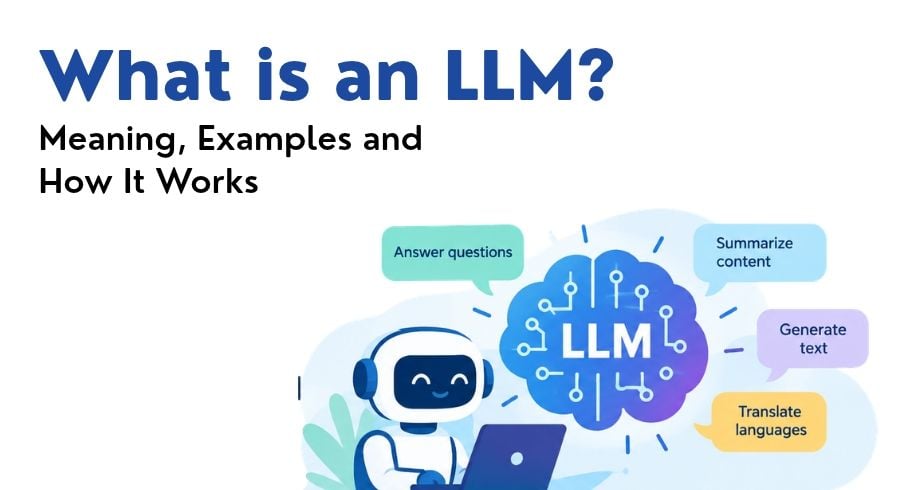
An LLM is an AI model that learns patterns from large amounts of data and uses them to generate relevant responses. It can answer questions, write content, summarise information, translate languages and generate code.
3. How do Large Language Models work?
Large Language Models process text by dividing it into tokens, analysing relationships between them and predicting subsequent tokens. Most modern LLMs use Transformer architecture and self-attention mechanisms to understand context and generate responses.
4. What are some popular examples of LLMs?
Popular LLM families include GPT by OpenAI, Gemini by Google, Claude by Anthropic, Llama by Meta and DeepSeek.
5. Is ChatGPT an LLM?
ChatGPT is an AI assistant powered by Large Language Models developed by OpenAI. It uses these models to understand user instructions and generate responses.
6. What is a token in an LLM?
A token is a unit of text processed by an LLM. It can represent a complete word, part of a word, punctuation mark or individual character.
7. What is prompt engineering in LLMs?
Prompt engineering is the practice of writing clear instructions and providing relevant context to guide an LLM towards a desired response. It helps improve the relevance, accuracy and usefulness of generated outputs.
8. Can LLMs generate incorrect information?
Yes. LLMs can produce inaccurate or misleading information, even when their responses sound convincing. These errors are known as hallucinations, which is why important information should always be verified.
9. What are the common business applications of LLMs?
LLMs are used in customer support, marketing, sales, software development, human resources, business research and analysis, and operations management. They help organisations automate routine tasks, process information and support business decisions.
Apply Now for MBA^/PGDM
Sources
[1] IBM – What Are Large Language Models (LLMs)?
[2] Google for Developers – Machine Learning Crash Course
[3] Google Cloud – Prompt Engineering for AI Guide
[4] Language Models are Few-Shot Learners
[5] What is Prompt Engineering?
Trending AI-based Knowledge Sharing Videos of Jaipuria Institute of Management

Prem Pandey
Prem Pandey is a Digital Marketing Manager with over 20 years of experience in SEO, content marketing, lead generation, brand building, and digital growth strategies. He specializes in driving online visibility, optimizing digital campaigns, and leveraging data-driven and AI-powered marketing solutions to enhance audience engagement and business performance.
Tags
AI HallucinationsChatGPTFoundation ModelsFuture of Large Language Models.Future of Large Language Models. LLMGenerative AIGenerative AI ModelsGPT ModelsGPT-4GPT-5How Do LLMs WorkLarge Language ModelLarge Language Models (LLM)LLM ApplicationsLLM ArchitectureLLM ExamplesLLM Fine-TuningLLM MeaningLLM TokensLLM TrainingLLM Use CasesLLM vs Generative AILLM vs SLMNatural Language Processing (NLP)Open-Source LLMsPrompt EngineeringRetrieval-Augmented Generation (RAG)Self-Attention MechanismSmall Language ModelsTransformer ArchitectureTransformer ModelsWhat Is an LLMWhat Is LLM