


AI is transforming Indian startups and SMEs through automation, analytics, customer support, marketing, inventory management, and business forecasting. This article explores practical AI applications, affordable tools, implementation challenges, and growth opportunities while highlighting how Jaipuria Institute of Management integrates AI, analytics, and digital business learning into management education.
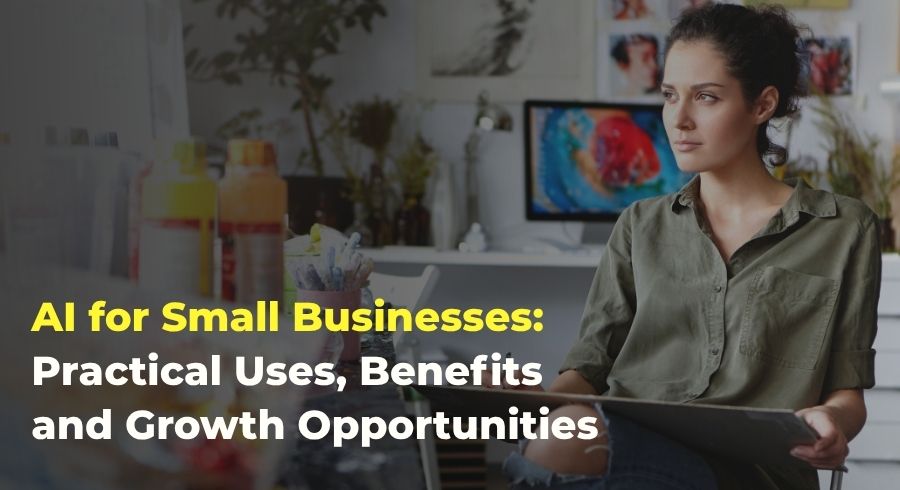
AI for Small Businesses: Practical Uses, Benefits and Growth Opportunities
Published: June 10, 2026,
12:53 pm
| Updated: June 10, 2026
Table of Contents
- Introduction
- Why AI Adoption Is Increasing Among SMEs
- Major Benefits of AI Adoption
- Industry-Specific AI Applications
- Risks and Challenges Businesses Should Understand
- A Practical Roadmap for Adoption
- Why Future Managers Need AI Understanding
- Closing Thoughts
- Frequently Asked Questions
- Sources
Introduction
Artificial intelligence is no longer limited to large corporations with massive technology budgets.
Cloud-based automation platforms and AI-driven business tools have made digital transformation accessible even to startups, retailers, local service providers, and MSMEs across India.
This shift is becoming increasingly important because smaller businesses often operate with limited manpower and operational bandwidth. Owners typically manage customer service, sales, finance, operations, and marketing simultaneously.
Automation helps reduce this burden by improving efficiency across repetitive tasks and operational workflows.
Key Takeaways
- AI tools are becoming increasingly accessible and affordable for Indian startups, retailers, and MSMEs.
- Customer support, marketing, accounting, and inventory management are among the most common and practical areas for small businesses to adopt AI.
- AI-enabled automation helps businesses improve operational efficiency, reduce repetitive work, and make faster business decisions.
- Future business growth will increasingly depend on how effectively SMEs adopt digital tools, analytics, and AI-driven business practices.
Why AI Adoption Is Increasing Among SMEs
Customer expectations have changed significantly over the last few years.
Faster responses, personalised communication, and digital convenience are now considered standard business expectations rather than premium experiences.
At the same time, smaller businesses face:
- Limited staff
- Budget constraints
- Rising competition
- Increasing customer acquisition costs
This is where AI-driven automation is creating measurable business impact.
Key Drivers Behind AI Adoption
| Driver | Business Impact |
| Affordable SaaS platforms | Lower entry barriers |
| Automation demand | Reduced manual workload |
| Digital competition | Better online visibility |
| Cloud infrastructure | Easier implementation |
| Data-driven operations | Faster decision-making |
Unlike traditional enterprise systems, many modern AI platforms require minimal setup and are designed for non-technical users.
PwC’s Global Artificial Intelligence Study estimates that AI could contribute nearly USD 15.7 trillion to the global economy by 2030 through productivity improvements and increased consumer demand.
Major Benefits of AI Adoption
For most SMEs, the value of AI lies less in “advanced technology” and more in solving operational inefficiencies.
Time Savings
Routine tasks such as:
- Responding to customer queries
- Generating invoices
- Scheduling appointments
- Creating social media captions
can now be automated.
This allows business owners to focus more on growth and customer relationships.
Lower Operational Costs
Automation reduces dependency on repetitive manual work while improving productivity.
Better Customer Experience
AI-enabled communication systems improve response speed and consistency.
Faster Decision-Making
Modern business tools analyse sales patterns, inventory movement, and customer behaviour significantly faster than manual processes.
Customer Support and Service Automation
Customer service is often the easiest and highest-ROI starting point for AI adoption.
Businesses increasingly use automation systems for:
- Handling FAQs
- Appointment booking
- Sending reminders
- Tracking orders
- Managing WhatsApp conversations
Popular Customer Automation Platforms
| Platform | Main Use |
| Tidio | Website chatbot |
| Zoho SalesIQ | Live support automation |
| Intercom | Customer engagement |
| Gupshup | WhatsApp automation |
For Indian businesses, WhatsApp automation has become especially useful because customers already prefer messaging-based communication.
Automation also improves responsiveness outside business hours without significantly increasing staffing costs.
AI-Powered Marketing and Content Creation
Marketing is one of the fastest-growing use cases for AI adoption among startups and SMEs.
Businesses can now generate:
- Social media content
- Product descriptions
- Email campaigns
- Ad copy
- Visual creatives
using low-cost or free AI tools.
Commonly Used Marketing Platforms
| Tool | Purpose |
| ChatGPT | Content generation |
| Canva AI | Design support |
| Google Ads AI | Campaign optimization |
| Meta Advantage+ | Advertising automation |
This helps growing brands maintain consistent digital visibility without relying heavily on agencies or large internal teams.
Inventory and Operations Management
Inventory management directly affects profitability and cash flow.
Too much stock increases holding costs, while stock shortages result in missed revenue opportunities.
AI-enabled forecasting systems help businesses:
- Predict demand
- Track purchasing behaviour
- Optimize procurement cycles
Operations and Inventory Platforms
| Tool | Core Function |
| Zoho Inventory | Demand forecasting |
| Vyapar | Billing and stock management |
| Unicommerce | Multi-channel inventory |
McKinsey’s operations research highlights that predictive supply chain and inventory systems improve operational resilience and planning efficiency during demand fluctuations.
Finance, GST and Accounting Automation
Accounting and compliance consume a major share of operational time for many SMEs.
AI-enabled accounting platforms simplify:
- GST filing
- Invoice generation
- Expense tracking
- Tax calculations
- Financial reporting
Accounting Platforms Used by Indian Businesses
| Platform | Key Capability |
| Tally Prime | Accounting + GST |
| Zoho Books | Cloud accounting |
| ClearTax | Tax compliance |
| Khatabook | Ledger management |
India-specific platforms have become particularly valuable because they align closely with local tax and compliance requirements.
HR and Workforce Management
Managing payroll and attendance manually becomes increasingly difficult as businesses grow.
HR automation systems streamline:
- Attendance tracking
- Payroll processing
- Leave management
- Employee onboarding
HR Management Platforms
| Tool | Main Function |
| Keka HR | HRMS + payroll |
| Razorpay Payroll | Salary automation |
| HRMantra | Workforce management |
Automation reduces administrative workload while improving accuracy and compliance management.
AI-Powered Sales and CRM Systems
Sales teams often lose opportunities because follow-ups are inconsistent or poorly tracked.
AI-enabled CRM systems improve visibility across the sales pipeline.
CRM Functions Enhanced Through AI
- Lead scoring
- Follow-up reminders
- Customer segmentation
- Sales forecasting
- Pipeline management
Popular CRM Platforms
| Tool | Key Strength |
| HubSpot CRM | Free CRM ecosystem |
| Zoho CRM | AI-driven insights |
| Freshsales | Pipeline automation |
For startups and growing companies, CRM systems often significantly improve conversion efficiency.
Industry-Specific AI Applications
AI adoption varies significantly across industries.
| Industry | Common Applications |
| Retail | Inventory forecasting |
| Restaurants | Order automation |
| Healthcare | Appointment scheduling |
| Education | Admissions support |
| Fashion & D2C | Social media automation |
| E-commerce | Product recommendations |
This shows that automation is becoming increasingly contextual and industry-specific rather than generic.
Risks and Challenges Businesses Should Understand
Despite the benefits, AI adoption also introduces operational and strategic risks.
Common Mistakes Businesses Make
Adopting Too Many Tools Simultaneously
Businesses often overcomplicate implementation.
Ignoring Human Oversight
AI-generated outputs still require review and validation.
Poor Employee Adoption
Teams must understand how to work effectively alongside automation systems.
Data Privacy Risks
Businesses handling customer information must comply with India’s Digital Personal Data Protection framework.
Technology adoption works best when aligned with clear business objectives rather than trend-driven experimentation.
A Practical Roadmap for Adoption
The most effective AI adoption strategy is gradual implementation.
Step 1: Identify Repetitive Tasks
Focus on processes consuming disproportionate operational time.
Examples include:
- Customer queries
- Billing
- Inventory updates
- Social media posting
Step 2: Start with One Tool
Implement one platform first rather than attempting a large-scale transformation immediately.
Step 3: Measure Outcomes
Track:
- Time saved
- Faster response rates
- Reduction in errors
- Revenue improvement
This creates clearer visibility into business impact and ROI.
Why Future Managers Need AI Understanding
AI adoption is increasingly becoming a strategic management capability rather than only a technical capability.
Business leaders now require:
- AI literacy
- Analytical thinking
- Technology evaluation skills
- Data-driven decision-making ability
This shift is also influencing management education.
Business schools are increasingly integrating analytics and AI literacy into management education to prepare students for technology-driven industries.
At Jaipuria Institute of Management, increasing emphasis is being placed on analytics-oriented learning, AI-enabled business exposure, and practical decision-making frameworks aligned with changing industry expectations.
Closing Thoughts
AI is gradually becoming an important part of how small businesses operate, compete, and grow in an increasingly digital economy.
From customer support and marketing to inventory management and financial operations, AI-enabled tools are helping startups, retailers, and MSMEs improve efficiency, reduce repetitive work, and make faster business decisions without requiring large operational teams.
As adoption increases, businesses will not only need access to the right tools but also the ability to use technology strategically and responsibly.
This shift is also influencing management education and workforce expectations. Companies increasingly value professionals who can combine business understanding with analytical thinking, digital adaptability, and technology-enabled decision-making.
At Jaipuria Institute of Management, increasing emphasis is being placed on analytics-oriented learning, AI-enabled business exposure, and practical decision-making frameworks aligned with evolving industry requirements.
For Indian SMEs, the long-term advantage will increasingly depend on how effectively businesses adapt to digital transformation, operational agility, and data-driven business practices.
Frequently Asked Questions
Can Indian SMEs afford AI tools?
Yes. Many automation platforms are free or available at low monthly subscription costs.
Which business functions benefit most from AI adoption?
Customer support, marketing, inventory management, and accounting usually generate the fastest operational improvements.
Is technical expertise required to use AI tools?
Most modern business platforms are designed for non-technical users.
Can AI improve customer engagement?
Yes. Chatbots and CRM systems improve responsiveness and personalisation.
Can automation reduce operating costs?
Automation reduces repetitive manual work and improves productivity.
How should businesses begin AI adoption?
Start with one repetitive process, implement one tool, and measure outcomes before scaling further.
Sources
- PwC: The Fearless Future: 2025 Global AI Jobs Barometer
- McKinsey: Supply-chain recovery in coronavirus times—plan for now and the future
- MEITY India – Data Protection Framework
Trending AI-based Knowledge Sharing Videos of Jaipuria Institute of Management

Sumit Pandey
Sumit Pandey is a Web Developer and technical content professional with expertise in modern web design, landing page development, responsive UI design, and content-driven digital experiences. Skilled in creating engaging websites and clear, research-driven technical content focused on performance, creativity, and user experience.