

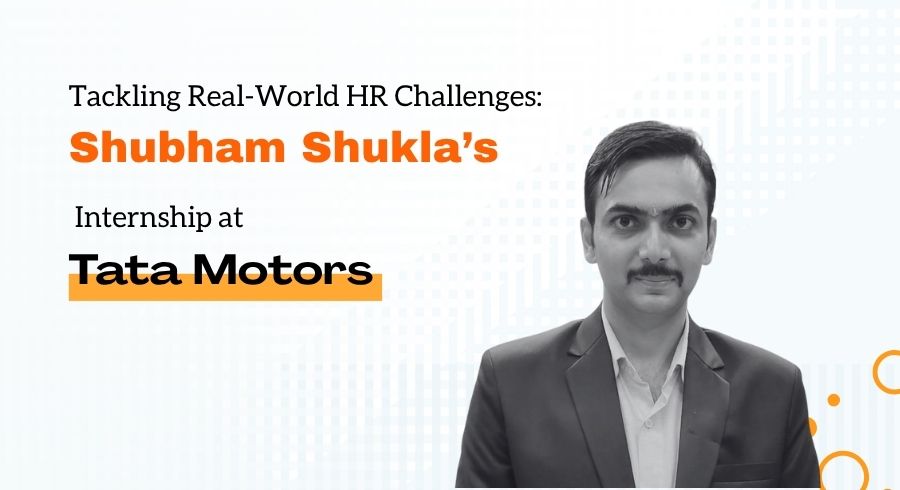
Explore how Shubham Shukla, a PGDM student at Jaipuria Institute of Management, Lucknow, applied classroom concepts to a live employee relations project at Tata Motors, gaining practical exposure to workforce management, stakeholder engagement, and industrial HR practices.
Home
›
Jaipuria Placements
›
Jaipuria Lucknow Placements
›
Shubham Shukla’s Summer Internship Journey at Tata Motors
Shubham Shukla’s Summer Internship Journey at Tata Motors
Published: June 25, 2026,
12:09 pm
| Updated: June 25, 2026
Summer Internships provide management students with an opportunity to apply classroom concepts in real business environments. For Shubham Shukla, a PGDM student specialising in Human Resource and Business Analytics at Jaipuria Institute of Management, Lucknow, the Summer Internship Programme (SIP) at Tata Motors became a valuable learning experience in employee relations, workforce management, and organisational dynamics.
About the Internship
Shubham completed his Summer Internship at Tata Motors under the guidance of the HR Senior Manager – Employee Relations. His project focused on analysing the flexi-employee lifecycle across various departments within the organisation.
The objective was to understand the experiences of flexi-employees at different stages of their journey and identify opportunities for improvement. The project required a combination of data collection, stakeholder interaction, qualitative analysis, and process evaluation.
The internship gave him a closer view of how employee relations functions contribute to maintaining a productive and supportive work environment.
Expectations Versus Reality
Before joining the organisation, Shubham expected the internship to be largely observational and centred around routine HR activities.
However, the experience proved to be far more engaging and responsibility-driven. Instead of simply observing processes, he was entrusted with a project that required active participation, independent analysis, and direct interaction with employees and managers.
The experience highlighted the strategic role of Human Resources in balancing business objectives with employee needs and workplace effectiveness.
Reflecting on the experience, Shubham shares:
“I perceived summer internships as primarily observational roles centered on administrative HR tasks. Instead, I found myself working on a strategic project that gave me exposure to employee relations and workforce management in a large manufacturing environment.”
Project Responsibilities
As part of his SIP project, Shubham conducted an end-to-end analysis of the flexi-employee lifecycle.
His responsibilities included:
- Studying recruitment and onboarding practices
- Understanding induction and integration processes
- Mapping employee experiences across departments
- Designing diagnostic questionnaires
- Gathering employee feedback
- Identifying challenges faced by flexi-employees
- Analysing findings and presenting observations
The project required him to interact with employees from different functions and understand how workforce experiences vary across operational settings.
This hands-on exposure helped him connect theoretical concepts from HR and Business Analytics with real workplace situations.
Understanding Workforce Diversity
One of the key learnings from the internship was understanding the complexity of managing a diverse workforce.
During discussions with employees, Shubham realised that workplace experiences and concerns often differed significantly across departments. Employees working on assembly lines, logistics operations, and support functions faced unique challenges that required different approaches and solutions.
This reinforced the importance of context-driven decision-making in Human Resource Management.
According to Shubham:
“What frustrates an employee on the assembly line might be entirely different from the concerns of someone in logistics. Adapting to this requires moving away from a one-size-fits-all mindset.”
The experience helped him appreciate the importance of listening, empathy, and stakeholder understanding when dealing with workforce-related issues.
Skills Developed During the SIP
The internship enabled Shubham to strengthen several technical and professional skills.
Workforce Lifecycle Analysis
He gained practical experience in studying employee journeys from recruitment to separation and identifying opportunities for process improvement.
Qualitative Research
Designing questionnaires, collecting feedback, and analysing employee perspectives enhanced his research capabilities.
Stakeholder Management
Interacting with employees, supervisors, and HR professionals helped him understand the importance of balancing multiple viewpoints.
Communication Skills
Conducting discussions and building rapport with employees improved his ability to communicate effectively across organisational levels.
Industrial Relations Exposure
The project provided valuable insights into employee relations, workforce engagement, and labour-management dynamics within a manufacturing environment.
Balancing Leadership and Internship Responsibilities
Alongside his internship, Shubham continued to serve as President of the Student Welfare and Disciplinary Committee at Jaipuria Institute of Management, Lucknow.
Managing responsibilities in both environments helped him further develop leadership, time management, and decision-making skills.
Reflecting on this experience, he says:
“Most interns observe from the sidelines, but I had to balance the analytical demands of my SIP at Tata Motors with my responsibilities as President of the Students Welfare Disciplinary Committee at Jaipuria. This helped me practice leadership in two very different environments simultaneously.”
The experience strengthened his ability to manage competing priorities while maintaining performance across multiple responsibilities.
Key Takeaways from the Internship
The most significant takeaway from the internship was gaining a deeper understanding of the role Human Resources plays in organisations.
For Shubham, the experience reinforced that effective HR management is not limited to policies and procedures. It also involves understanding employee concerns, fostering engagement, and creating systems that support both organisational goals and employee well-being.
As he explains:
“Human Resources is the bridge between operational efficiency and human dignity. Flexible labour is not just a headcount or a line item on a budget. It is a complex ecosystem that requires a balance of empathy, legal compliance, and strategic foresight.”
This perspective has shaped his approach towards HR and strengthened his interest in people-centric organisational practices.
Conclusion
Shubham’s SIP journey at Tata Motors demonstrates how practical industry exposure complements classroom learning. Through meaningful project work, stakeholder interactions, and real-world problem-solving, he developed a stronger understanding of workforce management and employee relations.
The experience not only enhanced his professional skills but also provided valuable insights into the human side of organisational success, an understanding that will continue to guide his future career.
Frequently Asked Questions (FAQs)
Which company did Shubham Shukla intern with during his SIP?
Shubham completed his Summer Internship Programme at Tata Motors.
What was Shubham’s project at Tata Motors?
His project focused on analysing the flexi-employee lifecycle, covering recruitment, onboarding, engagement, and separation processes across different departments.
What skills did he develop during the internship?
He developed skills in workforce lifecycle analysis, stakeholder management, qualitative research, communication, and industrial relations.
What was the biggest challenge during the internship?
Understanding the diverse concerns and experiences of employees across multiple functions and departments was one of the key challenges.
How did the internship contribute to his career goals?
The experience strengthened his interest in employee relations, people analytics, workforce strategy, and Human Resource Management.
Trending Placement Videos of Jaipuria Institute of Management
Prem Pandey
Prem Pandey is a Digital Marketing Manager with over 20 years of experience in SEO, content marketing, lead generation, brand building, and digital growth strategies. He specializes in driving online visibility, optimizing digital campaigns, and leveraging data-driven and AI-powered marketing solutions to enhance audience engagement and business performance.
Tags
Employee Relations InternshipHR and Business Analytics StudentHR Internship ExperienceJaipuria HR internship real project exposureJaipuria Lucknow SIPJaipuria MBA HR practical learning experienceJaipuria PGDM corporate internship journeyJaipuria student manufacturing internship experienceJaipuria Tata Motors internship experiencePGDM HR InternshipSummer Internship ProgrammeTata Motors SIP ExperienceWorkforce Management Internship