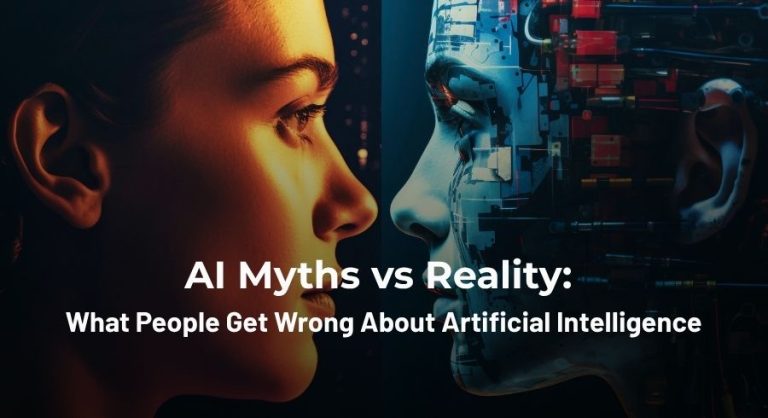







Misconceptions about artificial intelligence are widespread, ranging from fears of immediate job replacement to overestimation of AI’s current capabilities. This article separates AI myths from reality, examining what AI can genuinely do, where its limitations lie, and how businesses and students should think about AI accurately. Understanding the truth about AI is increasingly important for …
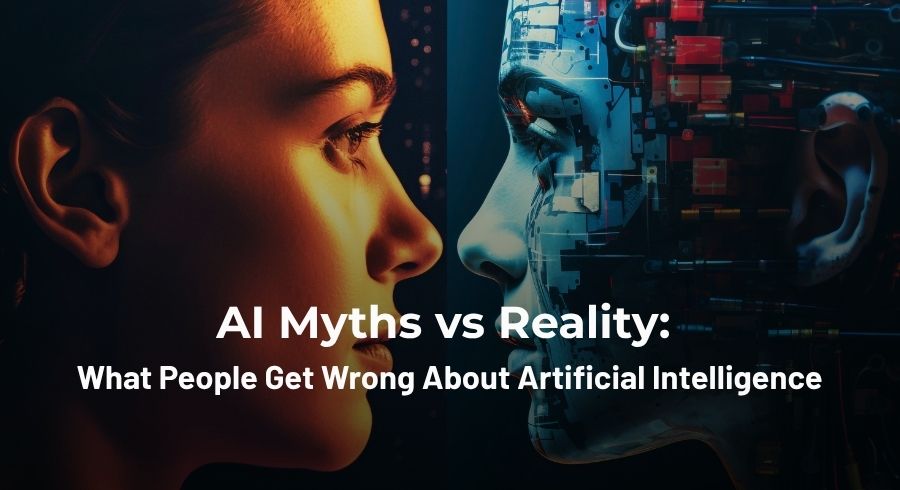
AI Myths vs Reality: What People Get Wrong About Artificial Intelligence
May 1, 2026,
3:52 pm
Artificial Intelligence Myths Explained
Artificial Intelligence(AI) is one of the most discussed and most misunderstood technologies in the world today.
Some people overestimate what AI can do, expecting it to replace entire professions overnight. Others underestimate it, assuming it is simply an advanced calculator with no bearing on their career or industry.
Neither view is accurate. Understanding AI realistically is one of the most valuable things a student or professional can do in 2026.
The Most Common AI Myths, Debunked
Myth 1: AI Will Replace All Jobs
Reality: AI replaces tasks, not roles.
The World Economic Forum’s Future of Jobs Report projects that while AI will displace some jobs, it will also create 69 million new roles by 2027, resulting in a net positive.
What AI replaces:
- Repetitive, rule-based tasks
- Data entry and basic processing
- Standardised customer queries
What AI cannot replace:
- Strategic judgement
- Emotional intelligence and leadership
- Creative problem-solving
- Relationship management
- Ethical decision-making
The roles most at risk are those defined almost entirely by routine execution. Management roles requiring judgement and leadership are not.
Myth 2: AI Is Always Right
Reality: AI systems make errors and inherit biases.
AI models are only as good as the data they are trained on.
Common AI failure modes:
- Biased outputs from biased training data
- Overconfidence in statistically incorrect predictions
- Failure in unfamiliar or edge-case scenarios
- Inability to account for context beyond training patterns
IBM and MIT research have documented cases of significant AI error rates in facial recognition, credit scoring, and hiring tools, particularly for underrepresented groups.
Myth 3: You Need to Be a Coder to Work With AI
Reality: Most AI roles in business require analytical thinking, not programming.
Business-focused AI roles require:
- Understanding what data is available and what it can reveal
- Ability to interpret and communicate AI outputs
- Judgement about when to trust and when to question AI recommendations
- Knowledge of relevant business context
At Jaipuria Institute of Management, GenAI for Managers is a mandatory core subject for all PGDM students regardless of specialisation. The Business Analytics specialisation includes Python and data tools, but the programme builds AI capability accessible to non-coders.
Myth 4: AI Understands Language the Way Humans Do
Reality: AI processes patterns, not meaning.
AI can generate fluent text, but does not possess human understanding or common sense.
- AI can produce plausible but incorrect statements
- It cannot reason from first principles like humans
- It lacks true comprehension beyond training data
Myth 5: AI Is a Recent Invention
Reality: AI has been in development since the 1950s.
| Year | Development |
|---|---|
| 1956 | The term “artificial intelligence” was coined at the Dartmouth Conference |
| 1997 | IBM’s Deep Blue defeats chess champion |
| 2011 | IBM Watson wins Jeopardy |
| 2016 | AlphaGo defeats Go champion |
| 2022 | ChatGPT reaches 100 million users |
| 2026 | AI embedded across industries |
Myth 6: AI Is Completely Objective
Reality: AI reflects the biases of its creators and data.
AI systems can reproduce historical inequalities present in training data.
Myth 7: AI Will Become Conscious and Uncontrollable
Reality: Current Artificial Intelligence(AI) systems have no consciousness or self-awareness.
They do not have intentions, desires, or independent goals.
Myth 8: AI Is Only Relevant for Tech Companies
Reality: AI is transforming every industry.
- Healthcare – diagnostic imaging
- Agriculture – crop monitoring
- Finance – fraud detection
- Retail – demand forecasting
- Education – adaptive learning
- Manufacturing – predictive maintenance
- Consulting – data-driven strategy
Myth 9: AI Tools Can Replace Formal Education
Reality: Artificial Intelligence(AI) tools accelerate learning; education converts it into outcomes.
Formal education provides structured placements, networks, mentorship, and credentials that AI tools alone cannot replicate.
Myth 10: AI Is Too Complex for Non-Technical Professionals
Reality: Business-level AI literacy is accessible and essential.
It requires understanding what AI can and cannot do, not programming expertise.
Conclusion
Understanding AI accurately matters. Overestimating it creates fear, while underestimating it creates missed opportunities.
The professionals who succeed will be those who understand both its power and its limitations and apply it effectively in business contexts.
Institutions like Jaipuria Institute of Management are preparing students through AI-native education that combines technical literacy with business application and ethical reasoning.
Frequently Asked Questions
Will AI really replace human jobs?
AI will automate tasks but also create new roles, leading to net job growth according to global reports.
Is Artificial Intelligence(AI) always accurate?
No. AI systems can produce errors and biased outputs.
Do you need coding to work with AI?
No. Business AI roles focus on interpretation and decision-making.
Can AI think like humans?
No. Artificial Intelligence(AI) does not have consciousness or true understanding.
Is AI relevant outside tech?
Yes. AI is used across all major industries.
Are fears about uncontrollable AI justified?
No. Current AI has no autonomy or consciousness.
Can non-technical students study AI?
Yes. AI literacy is accessible and increasingly important in management education.
What is most important about AI in 2026?
Understanding what Artificial Intelligence(AI) can and cannot do, and using it responsibly in professional contexts.
Trending AI-based Knowledge Sharing Videos of Jaipuria Institute of Management

Tags
AI facts and mythsAI facts IndiaAI fears debunkedAI limitations 2026AI misconceptionsAI myths debunkedAI myths vs realityai-literacyai-mythsArtificial IntelligenceBusiness Analyticscommon AI myths IndiaDigital TransformationFuture of WorkGenAIJaipuria AI curriculumJaipuria GenAI for ManagersJaipuria Institute of ManagementJaipuria PGDM Noidamachine-learningManagement Educationmba-aitechnology-trends-indiatruth about artificial intelligence