



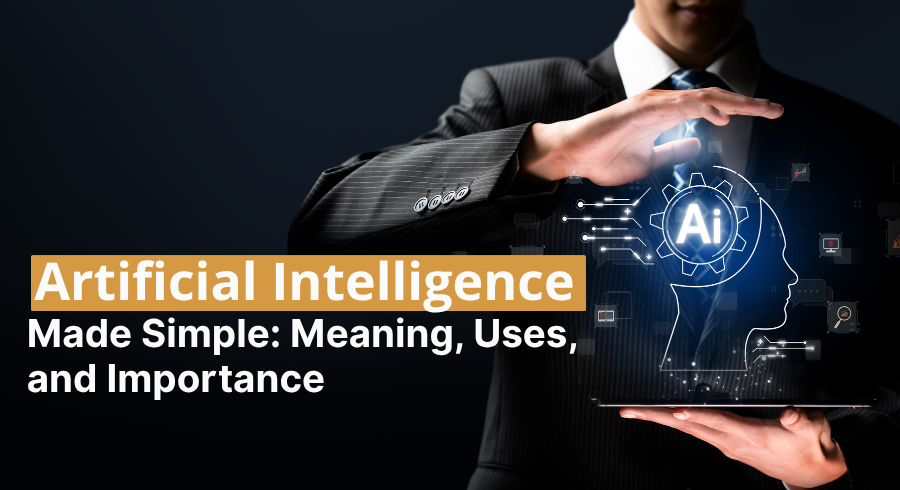
Artificial intelligence is reshaping how businesses operate and how professionals make decisions. This article explains what AI is, how it works, and why it matters in plain, accessible language. Jaipuria Institute of Management reflects this shift directly in its curriculum, embedding AI literacy through GenAI for Managers, an applied AI lab, and tools like AI-Lingo …
Home
›
Jaipuria Featured Stories
›
Artificial Intelligence Made Simple: Meaning, Uses, and Importance
Artificial Intelligence Made Simple: Meaning, Uses, and Importance
Published: April 1, 2026,
6:04 pm
| Updated: June 25, 2026
Artificial intelligence is one of the most discussed and least clearly explained concepts in contemporary life. It appears in news headlines, business strategy documents, and everyday conversation, often with the assumption that everyone already understands what it means. A clear, grounded understanding of what AI actually is, how it works, and why it matters is more useful and less common than the volume of coverage might suggest.
This article provides that understanding, without unnecessary technical complexity.
What is Artificial Intelligence?
In simple terms, artificial intelligence refers to the ability of machines or software to perform tasks that would normally require human intelligence. These tasks include:
- Recognising patterns in data, such as identifying objects in images or detecting fraud in financial transactions.
- Understanding and generating language, as seen in tools like ChatGPT and Google Search.
- Making decisions based on available information, such as recommending a product or approving a loan.
- Learning from experience means improving performance over time as more data becomes available.
Unlike traditional software that follows fixed, pre-programmed rules, AI systems learn from data, adapt to new situations, and improve over time. This ability to continuously learn and evolve is what makes AI fundamentally different from conventional programming.
Apply Now for MBA^/PGDM
At Jaipuria Institute of Management, this distinction is introduced early in the programme so that students understand not just what AI does, but how it changes decision-making in real business contexts.
How Does Artificial Intelligence Work?
AI works through a combination of underlying technologies that work together to enable intelligent behaviour:
Machine Learning
Machine learning allows systems to identify patterns in data without being explicitly programmed with rules. For example, instead of being told what a cat looks like, a model learns from thousands of images labelled “cat” and recognises patterns on its own.
Deep Learning
A more advanced form of machine learning that uses layered neural networks to process complex data such as images, speech, and text. Most modern AI breakthroughs are driven by deep learning.
Natural Language Processing (NLP)
This enables machines to understand and generate human language. It powers chatbots, translation tools, and AI assistants.
Programmes at Jaipuria Institute of Management introduce these concepts through applied learning rather than theory alone, helping students connect these technologies directly to business use cases.
Best MBA Colleges in Delhi NCR
Types of Artificial Intelligence
AI can be classified into three broad categories based on capability:
- Narrow AI — Designed for specific tasks and highly efficient within its domain. All AI that currently exists falls into this category. ChatGPT, Siri, fraud detection systems, and recommendation engines are all examples of narrow AI.
- General AI — A hypothetical system capable of performing any intellectual task a human can, across all domains. This does not currently exist.
- Super AI — A hypothetical system that surpasses human intelligence across all domains. This remains firmly in the territory of speculation.
Real-Life Examples of AI
AI is already deeply embedded in everyday life in ways that most people do not consciously register:
- Google Maps uses AI to predict traffic and optimise routes
- Netflix and YouTube recommend content based on viewing history
- Bank fraud detection systems identify suspicious transactions in real time
- Voice assistants responding to spoken queries
- E-commerce platforms suggest products based on browsing behaviour
- Email spam filters classify incoming messages automatically
These examples illustrate how AI enhances convenience, personalisation, and efficiency across everyday experiences in ways that have become so normal they are largely invisible.
Why AI Matters for Students and Professionals
Understanding AI is no longer optional—it is a baseline professional skill. Managers today are expected to interpret AI-generated insights, work with data-driven systems, and make decisions in AI-augmented environments. Professionals who lack this capability are at a structural disadvantage across industries in 2026.
This is why institutions like the Jaipuria Institute of Management integrate AI into the core learning experience. Through core courses such as “GenAI for Managers,” along with initiatives like “AI-Lingo” that simplify concept understanding, students build practical familiarity with AI tools and frameworks as part of their everyday coursework rather than as an optional add-on.
Group Discussion Topics
Common Misconceptions About AI
Several persistent misconceptions about AI are worth addressing directly:
- AI is not conscious—it does not think or feel
- AI is not always accurate—it depends heavily on data quality
- AI is not magic—it is based on mathematical models and data patterns
- AI is not autonomous in the way science fiction suggests
Understanding these boundaries is as important as appreciating what AI can do. It is what distinguishes professionals who use AI intelligently from those who either fear it irrationally or trust it uncritically.
Conclusion
Artificial intelligence is not a future concept waiting to arrive—it is already embedded in how businesses operate and decisions are made. For students and professionals, understanding AI is not about becoming technical experts but about developing the ability to work alongside intelligent systems effectively.
MBA Entrance Exams
Management institutions that recognise this shift, such as Jaipuria Institute of Management, are preparing students to engage with AI not just as users, but as decision-makers who can apply it thoughtfully in real-world business contexts.
Frequently Asked Questions
What is the simplest definition of artificial intelligence?
The ability of machines or software to perform tasks that would normally require human intelligence, such as recognising patterns, understanding language, making decisions, and learning from experience.
What is the difference between AI and machine learning?
Machine learning is a subset of AI. AI is the broader concept of machines performing intelligent tasks. Machine learning is the specific method by which many AI systems develop their capabilities through training on large datasets.
Is AI the same as a robot?
Not necessarily. Robots are physical machines that can be controlled by AI, but AI itself is a software. Most AI applications do not involve robots.
Can AI think and feel like a human?
No. Current AI systems process information and produce outputs based on statistical patterns in training data. They do not have consciousness, emotions, or subjective experience.
What is the difference between narrow AI and general AI?
Narrow AI performs specific tasks and is all that currently exists. General AI, which does not yet exist, would be capable of performing any intellectual task a human can across all domains without specific training for each.
How does Jaipuria Institute of Management help students understand AI?
Jaipuria Institute of Management helps students understand AI through simplified learning tools like AI-Lingo and hands-on platforms such as Rehearsal and the Interview Question Assistant. It further reinforces learning through a Campus Intelligence assistant and immersive AI-driven simulations, ensuring students actively apply AI in real-world scenarios.
Why is AI important for MBA students to understand?
Because AI is reshaping how organisations make decisions, manage operations, and compete. MBA graduates who understand AI can direct it effectively, evaluate its outputs critically, and lead organisations through technology-driven change.
What are the most common everyday applications of AI?
Search engines, social media recommendations, voice assistants, spam filters, navigation applications, streaming service recommendations, and fraud detection systems.
Is AI dangerous?
AI carries real risks, including algorithmic bias, privacy concerns, and potential for misuse, which are the subject of active regulatory and ethical attention globally.
How can beginners start learning about AI?
Start with accessible explanations of core concepts, explore free tools like ChatGPT and Claude in everyday tasks, take structured online courses from credible providers, and look for practical applications in your own field of interest. Building familiarity through use is often more effective than purely theoretical study.
Trending AI-based Knowledge Sharing Videos of Jaipuria Institute of Management

Srishti Gupta
A passionate content writer with expertise in creating research-driven and engaging content on management education, AI, careers, and business trends. Skilled at transforming complex ideas into clear, reader-friendly narratives while maintaining authenticity and credibility. Focused on delivering insightful and impactful content that informs, inspires, and creates meaningful value for readers.
Tags
AI conceptsAI definitionAI explained simplyAI for beginnersAI simple explanationartificial intelligence 2026artificial intelligence basicshow AI worksJaipuria AI LabJaipuria AI literacyJaipuria AI nativeJaipuria AI-LingoJaipuria GenAIJaipuria Institute of Managementunderstanding AIwhat is artificial intelligence