



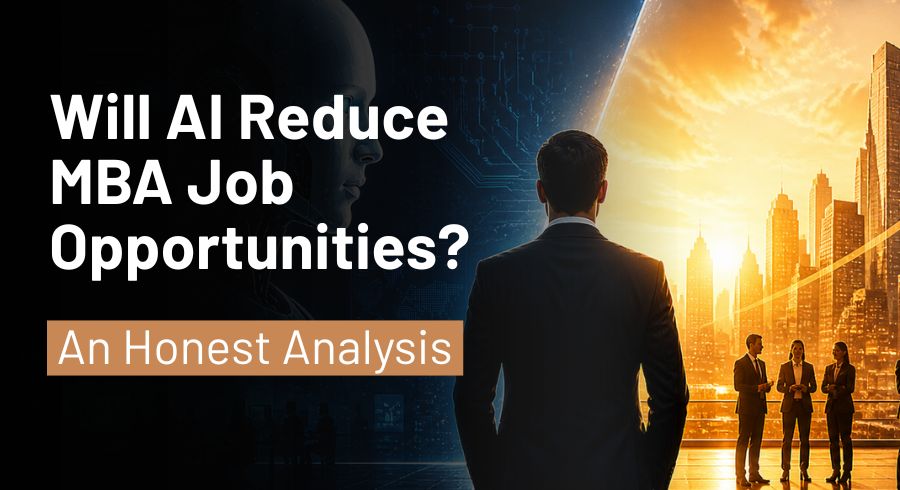
Artificial intelligence is transforming the nature of management work, and the question of whether it will reduce or reshape MBA job opportunities is one of the most important career questions of 2026. This article examines the evidence honestly, distinguishing between roles that AI is genuinely threatening, functions it is augmenting, and entirely new categories of …
Will AI Reduce MBA Job Opportunities? An Honest Analysis for 2026
May 4, 2026,
6:35 pm
Will AI Reduce MBA Job Opportunities? This is one of the most frequently asked questions among MBA aspirants in India, and it deserves an honest answer rather than either reassuring dismissal or unnecessary alarm.
The short answer is this: AI will reduce demand for some management roles, significantly augment others, and create entirely new categories of work that did not exist five years ago. The net effect on MBA employment is not negative. But the distribution of that employment is shifting in ways that make some MBA graduates significantly more competitive and others significantly less so, depending almost entirely on the skills and mindsets they develop during their programmes.
According to the World Economic Forum’s Future of Jobs Report, AI is expected to displace approximately 85 million jobs globally while simultaneously creating approximately 97 million new roles. The net figure is positive, but the composition changes substantially, and the management profession is not exempt from disruption within that net-positive picture.
What the Evidence Actually Shows About Management Job Displacement
The fear that AI will eliminate MBA jobs is not entirely without foundation, but it is frequently applied to the wrong roles and the wrong level of severity.
AI is genuinely good at tasks involving pattern recognition in structured data, generating outputs from defined inputs, processing large volumes of information quickly, and automating workflows that follow predictable rules. A substantial proportion of what junior management professionals have traditionally done in their first two to three years after an MBA falls squarely into these categories: financial modelling based on standard templates, generating market research summaries, producing management reporting decks, analysing customer datasets, and drafting routine business communications.
McKinsey and Company’s research on automation potential across occupations estimates that approximately 60 to 70 percent of the tasks in a typical management role are potentially automatable with current or near-future AI capability. This is a striking figure, and it is frequently cited in discussions about AI and employment. However, the critical distinction is between automating tasks and eliminating roles. Most management roles involve a mix of automatable tasks and tasks that require human judgment, stakeholder relationships, ethical reasoning, and contextual understanding. AI automates the former, which changes the job but does not eliminate it.
The roles where genuine employment displacement is occurring are those that are almost entirely composed of automatable tasks with little human judgment required. Entry-level data entry and reporting roles, basic financial analysis that follows standardised templates, routine customer communication management, and first-draft document production are all seeing AI absorption. These are the roles that many fresh management graduates used to occupy in the first eighteen months of their careers.
This displacement is real and is already visible in hiring patterns. According to LinkedIn’s global talent trends data, entry-level business analyst and management reporting roles have seen a meaningful reduction in new position creation at many large organisations since 2023, while more senior roles requiring interpretation, decision-making, and stakeholder management have seen growing demand.
Where AI Is Augmenting Rather Than Replacing MBA Roles
The more accurate and more useful frame for most management roles is augmentation rather than replacement. AI is not eliminating the need for managers. It is changing what managers spend their time on and raising the standard for what constitutes genuine managerial value.
In consulting, AI tools are dramatically accelerating the research, data analysis, and document production phases of client work. Deloitte’s internal productivity research indicates that consultants using AI tools complete comparable research and drafting work in significantly less time than before. But the work that clients pay consulting firms for, the strategic insight, the stakeholder facilitation, the organisational change leadership, is being done by people. The junior consultant who previously spent 60 percent of their time on research and document production now spends that time on higher-value analysis and client interaction. The job has changed, but it has not disappeared.
In marketing, AI tools handle campaign optimisation, content variation testing, and performance analytics at a speed and scale that human teams cannot replicate. But the brand strategy, the creative direction, the consumer insight synthesis, and the commercial judgement that determines which direction to pursue remain distinctly human. Marketing MBA graduates who understand how to use AI tools to amplify their strategic capability are more productive and more valuable than those who do not, but they are not being replaced.
In finance, AI handles routine financial modelling, regulatory reporting automation, and anomaly detection in transaction data. According to the Reserve Bank of India’s assessments of AI adoption in Indian banking, AI-driven processes are improving speed and accuracy significantly while requiring more, not fewer, finance professionals who can interpret model outputs, manage model risk, and make judgements that models cannot make.
The pattern across functions is consistent. AI is absorbing the routine, structured, and repetitive components of management work. It is raising the floor of what is expected from human contributors and shifting the value of human professionals towards interpretation, judgment, leadership, creativity, and ethical reasoning, which are the capabilities that MBA programmes are specifically designed to develop.
The Roles That Face Genuine Risk
Honest analysis requires acknowledging where the risk to management employment is most concentrated, rather than dismissing it entirely.
Middle management roles in large organisations, particularly those whose primary function is information aggregation and upward reporting, face meaningful medium-term risk. AI systems that can synthesise performance data, generate variance reports, and flag issues in real time reduce the need for layers of management whose primary contribution was information processing. According to research from Harvard Business Review, several large technology and financial services companies have already begun reducing middle management headcount as AI reporting tools have made those layers less necessary.
Roles that primarily involve applying a fixed analytical framework to standardised data, such as certain credit analyst functions, basic financial audit support, and routine market research, are also seeing AI absorption. These are not being eliminated overnight, but the volume of human resources required to perform them is declining at some organisations.
For MBA graduates, the practical implication is to assess their target roles honestly against this framework. A role whose primary value is executing a well-defined analytical process is more exposed than one whose primary value is navigating ambiguity, managing relationships, or making judgments under uncertainty with incomplete information.
NASSCOM’s employment data confirms that roles emphasising routine analysis are seeing flat or declining demand, while roles emphasising strategic thinking, stakeholder management, and AI-integrated decision-making are growing at 20 to 30 percent annually. This divergence is the most important signal for MBA specialisation and career planning.
What This Means for MBA Relevance
The question of whether AI reduces MBA job opportunities cannot be separated from the question of which MBA and which graduate.
An MBA that builds only traditional management knowledge without analytical depth or AI literacy produces graduates who are exposed to the displacement risk described above. An MBA that combines management fundamentals with genuine analytical capability, AI tool proficiency, and the leadership skills that AI cannot replicate produces graduates who are more competitive in an AI-driven market than in any previous era.
This is the institutional challenge that separates forward-looking management education from programmes that have not adapted. According to GMAC’s employer survey, the skills most sought from MBA graduates have shifted significantly in the past five years: analytical thinking, AI tool proficiency, and data-driven decision-making are now in the top five requirements, alongside the traditional leadership and communication competencies that have always been valued.
Jaipuria Institute of Management’s response to this challenge is embedded in its programme architecture. GenAI for Managers is a mandatory core subject for all students, ensuring that every graduate has working proficiency with AI tools as a baseline, regardless of their specialisation. The Business Analytics specialisation develops deeper technical capability through courses in Python for Business Analytics, Machine Learning, Artificial Intelligence, Data Visualisation, and Text Analytics and NLP. The immersive simulations, including CrYsis for crisis decision-making and Propaganda Wars for strategic persuasion, build precisely the contextual judgment and leadership under ambiguity that AI cannot replicate.
The AI-native learning ecosystem at Jaipuria, including Rehearsal for interview simulation, the Interview Question Assistant, Resume Evaluator, Persona Play, and AI-Lingo, means that AI is embedded in how students learn throughout the programme, not just what they study in a single course. This produces graduates who arrive in their first roles already comfortable working alongside AI tools, which is increasingly the baseline expectation of employers across sectors.
How to Future-Proof an MBA Career in the AI Era
For MBA students and aspirants evaluating their career prospects in an AI-shaped market, the practical implications are clear.
Specialise in areas where AI augments rather than replaces human value. Business Analytics, Finance with quantitative depth, Strategy and Consulting, and AI-adjacent product management are growing faster than general execution-focused management roles. This is not about chasing trends; it is about aligning with structural market dynamics that are well-documented and likely to persist.
Develop genuine AI tool proficiency rather than surface familiarity. Employers can identify the difference between a candidate who has read about AI and one who regularly uses it in professional contexts. The MBA/PGDM programme is the ideal environment to develop this proficiency because it provides both the tools and the business context in which to apply them.
Invest in the capabilities that AI cannot replicate. Communication, ethical judgement, leadership under ambiguity, stakeholder management, and cross-cultural navigation are not automatable. These are the qualities that justify human professionals in an AI-enabled organisation, and they are precisely the qualities that strong MBA programmes build through two years of immersive learning, peer interaction, and industry exposure.
Conclusion
AI will not reduce overall MBA job opportunities. It is already reshaping which opportunities grow and which decline, and it is raising the minimum capability threshold for MBA graduates to be genuinely competitive.
The MBA graduates who face the greatest risk are those from programmes that have not adapted to this new market reality: who arrive in their first roles without AI literacy, without analytical capability, and with skills profiles built for an execution-focused management environment that is already changing.
The MBA graduates who face the strongest opportunities are those from forward-looking institutions like Jaipuria Institute of Management who arrive with genuine AI proficiency alongside the management fundamentals, leadership capability, and professional network that the degree has always provided.
The question for MBA aspirants is therefore not whether to pursue an MBA in the age of AI. It is whether to choose a programme that is genuinely preparing them for that age, or one that is still preparing them for the age before it.
Frequently Asked Questions (FAQs)
Will AI eliminate MBA jobs in India?
No. AI is changing which tasks MBA graduates perform and raising the skill expectations for remaining competitive.
Which MBA roles are most at risk from AI?
Middle management roles primarily focused on information aggregation and reporting, routine financial analysis following fixed templates, and entry-level roles dominated by structured data processing are most exposed.
Which MBA specialisations are most AI-proof?
Business Analytics, Consulting and Strategy, AI-adjacent product management, and HR Analytics are the most resilient and fastest-growing. These combine human judgement with AI tool capability in ways that are difficult to fully automate.
Is an MBA still worth pursuing in an AI era?
Yes, more than ever, provided the institution genuinely integrates AI into its curriculum. An MBA that produces graduates with both management fundamentals and AI literacy is more valuable in 2026 than at any previous point.
How does Jaipuria Institute of Management prepare graduates for AI-era careers?
Through mandatory GenAI for Managers, a comprehensive Business Analytics specialisation with Python and Machine Learning, AI-powered learning tools including Rehearsal and the Interview Question Assistant, and immersive simulations that develop the contextual judgement and leadership capability that AI cannot replicate.
Are campus placements at MBA institutions being affected by AI?
At strong, AI-adapted institutions, placement volumes and package levels have not declined. At Jaipuria Institute of Management, the 2024-26 batch received 600 plus offers from 275 plus recruiters. The market is shifting, not contracting.
What skills should MBA graduates develop to remain competitive against AI?
Analytical and AI tool proficiency, strategic thinking, stakeholder management, communication, ethical judgement, and leadership under ambiguity. These are the capabilities AI augments but cannot replicate.
Which industry is hiring MBA graduates most actively in the AI era?
Consulting, BFSI analytics, product management, and AI-oriented e-commerce roles are the most active and fastest-growing hiring categories for analytically capable MBA graduates in India.
Trending AI-based Knowledge Sharing Videos of Jaipuria Institute of Management

Prem Pandey
Prem Pandey is a Digital Marketing Manager with over 20 years of experience in SEO, content marketing, lead generation, brand building, and digital growth strategies. He specializes in driving online visibility, optimizing digital campaigns, and leveraging data-driven and AI-powered marketing solutions to enhance audience engagement and business performance.
Tags
AI and MBA employment IndiaAI effect on MBA placementsAI impact on MBA jobs IndiaAI job displacement MBA graduatesAI replacing management jobs IndiaJaipuria AI curriculumJaipuria Business AnalyticsJaipuria GenAI for ManagersJaipuria Institute of ManagementJaipuria MBA placement AI eramanagement jobs AI 2026 IndiaMBA career future AI eraMBA job opportunitiesMBA relevance AI eraWill AI reduce Management jobsWill AI reduce MBA job opportunitiesWill AI reduce MBA jobs