

The AI revolution is creating entirely new categories of professional roles that did not exist a decade ago. From AI ethics officers and prompt engineers to machine learning product managers and digital transformation consultants, the career landscape is being fundamentally reshaped. This article maps the most significant emerging careers created by AI, what each requires, …
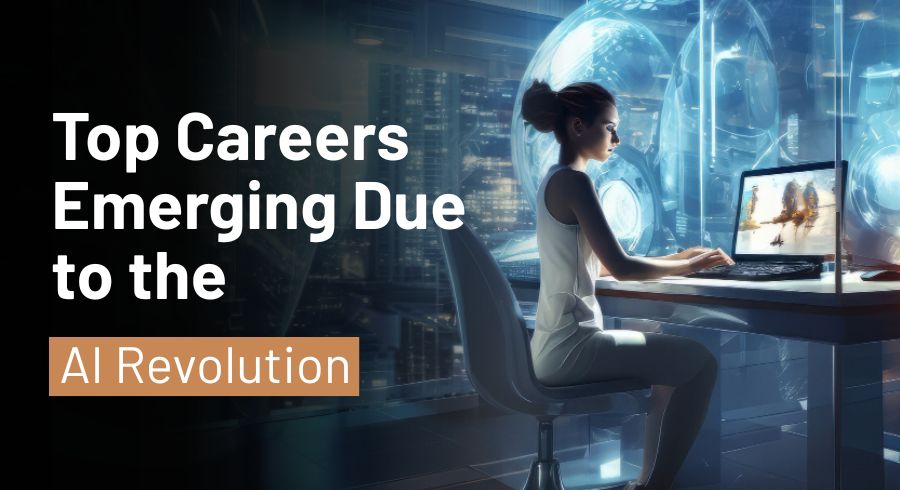
Top Careers Emerging Due to the AI Revolution in 2026
May 4, 2026,
4:51 pm
The rapid advancement of artificial intelligence is reshaping how organisations operate and how careers evolve across industries. This shift is most visible in the top careers emerging due to the AI revolution.
The World Economic Forum’s Future of Jobs Report reflects this shift, projecting the creation of 69 million new roles globally by 2027, even after accounting for displacement from automation. Many of these roles did not exist five years ago, have no direct historical precedent, and require a combination of technical literacy, business judgement, and human communication skills that is genuinely new in the labour market.
For students and professionals in India, this changing landscape makes it essential to understand which roles are emerging, what they pay, and what they require. NASSCOM’s annual industry reports consistently identify AI-adjacent roles as the fastest-growing and among the highest-compensated management positions in the country, with demand outpacing talent supply significantly across most categories.
How to Think About AI-Emerging Careers
Emerging AI careers fall into four distinct categories that are useful to understand before examining specific roles.
The first is AI-native technical roles, which exist specifically because of AI technology and require deep technical knowledge to perform: machine learning engineers, MLOps specialists, and AI researchers.
The second is AI-augmented management roles, which are existing management positions transformed by AI capability in ways that create entirely new value and require new skills: AI-enabled product managers, analytics consultants, and digital transformation leaders.
The third is AI governance and ethics roles, which manage the risks, oversight, and responsible deployment of AI systems: AI ethics officers, responsible AI managers, and model risk governance specialists.
The fourth is AI application roles, which apply AI tools and insights in specific industry contexts: healthcare AI managers, supply chain analytics leaders, and generative AI content strategists.
The fastest job growth is occurring in the second and third categories, where management education is the most natural preparation pathway. Technical AI roles are also growing rapidly, but require engineering or data science foundations. The most significant shortfall of talent in India is in AI-augmented management and AI governance roles, because there are far more organisations trying to apply AI commercially than there are professionals who can lead that application effectively.
AI Product Manager
This is consistently identified by LinkedIn as one of the fastest-growing and best-compensated management roles in India, and it is highly accessible to MBA graduates with the right preparation.
AI product managers define and drive the development of AI-powered products and features, from intelligent recommendation systems and automated customer service platforms to AI-driven financial products and smart logistics tools. They translate business requirements into product specifications, prioritise development roadmaps, define success metrics, and lead cross-functional teams that include engineers, data scientists, designers, and commercial stakeholders.
The role sits squarely at the intersection of business strategy and technology, making it one of the most natural MBA-to-career pathways in the AI era. What makes an AI product manager different from a traditional product manager is the requirement to understand AI system capabilities and limitations well enough to make informed product decisions, evaluate feasibility claims from engineering teams, and manage stakeholder expectations about what AI can and cannot reliably deliver.
Salary ranges in India run from approximately INR 18 to 25 LPA at the entry level for fresh MBA graduates to INR 40 to 70 LPA at mid-senior levels, with ESOPs adding significantly at startups and technology companies.
Companies actively hiring for this profile include Amazon, Flipkart, Razorpay, PhonePe, and a growing number of B2B SaaS businesses.
At Jaipuria Institute of Management, the Business Analytics specialisation, combined with the mandatory GenAI for Managers course, creates exactly the profile that AI product management roles require. Understanding machine learning model limitations, data requirements for AI applications, and how to translate business problems into AI product specifications are all developed through Jaipuria’s curriculum covering Python for Business Analytics, Machine Learning, Artificial Intelligence, and Digital Transformation.
Prompt Engineer
Three years ago, this role did not exist. Today, it appears in job listings across marketing agencies, technology companies, HR technology firms, consulting houses, and financial services organisations, and it is growing faster than most analytical roles.
Prompt engineers design, test, and refine the inputs that large language models receive in order to produce accurate, commercially useful, and contextually appropriate outputs at scale. As organisations embed generative AI into customer service, content production, compliance monitoring, and knowledge management workflows, the quality of the prompts that drive these systems determines whether the AI deployment delivers business value or produces frustrating and unreliable results.
The role requires a combination of linguistic precision, analytical experimentation, domain knowledge in the specific area where AI is being applied, and a systematic approach to testing and iteration. It does not require the ability to build AI models, but it does require a genuine understanding of how large language models work, what biases they carry, and what constraints produce reliable outputs.
Salary ranges in India are evolving rapidly, currently running from approximately INR 8 to 18 LPA at the entry level to INR 25 to 40 LPA for specialists with proven track records. The role is genuinely accessible to MBA graduates with strong analytical and communication skills who develop AI tool proficiency during their programmes.
AI Ethics and Governance Officer
As organisations deploy AI at scale, the ethical, legal, and reputational risks of unmanaged AI systems have become significant board-level concerns. This has created a new professional category with no historical precedent.
AI ethics and governance officers design and implement frameworks for responsible AI deployment within organisations. This includes conducting bias audits on AI models before deployment, ensuring that AI decision-making processes comply with applicable regulations, managing model risk for financial and credit AI systems, and communicating AI governance posture to regulators, investors, and other stakeholders.
The role is growing most rapidly in financial services, healthcare, large technology companies, and government-adjacent organisations where the regulatory stakes of AI errors are highest. The EU AI Act, SEBI’s increasing attention to AI governance in financial markets, and NASSCOM’s published responsible AI guidelines for India are all creating institutional demand for professionals who can translate governance requirements into practical operational frameworks.
According to Deloitte’s AI governance survey, demand for AI ethics and compliance roles grew by approximately 85 percent between 2022 and 2024, making it one of the fastest-growing specialist management functions globally. Salary ranges in India currently run from INR 15 to 20 LPA at entry level to INR 40 to 60 LPA for experienced practitioners at established organisations.
MBA graduates are well-positioned for this role because it requires ethical reasoning, regulatory awareness, stakeholder management, and enough technical understanding to engage credibly with AI teams, which is precisely the combination that management education and business ethics training develop. Jaipuria Institute of Management’s mandatory Business Ethics and Sustainability workshop based course directly develops the ethical reasoning framework that these roles require, alongside the AI curriculum that provides technical context.
Digital Transformation Consultant
This is one of the most rapidly expanding management roles in India and globally, created by the fact that every organisation in every sector is simultaneously trying to integrate AI and digital tools into core operations while most of them lack the internal capability to do so effectively.
Digital transformation consultants help organisations identify where AI and digital technology create genuine business value, design the roadmaps and change management processes required to capture that value, select and evaluate vendors, and manage the human and organisational dimensions of technology adoption. They are not primarily technology specialists; they are business strategists who understand technology well enough to connect it to commercial reality.
Consulting firms including Deloitte, Accenture, KPMG, and PwC have all significantly expanded their digital transformation practices in India over the past three years. Technology companies including Microsoft, SAP, and Salesforce have built professional services practices around helping customers transform digitally. The market for this capability is large, growing, and currently undersupplied with professionals who have both the business breadth and the technology literacy the role requires.
Salary ranges run from approximately INR 15 to 22 LPA for fresh MBA entrants into consulting digital practices to INR 40 to 70 LPA for experienced practitioners with track records of successful transformation programmes. Deloitte’s consistent campus recruitment from Jaipuria Institute of Management reflects this consulting demand for analytically capable management graduates with AI literacy.
HR Analytics
The application of AI to talent management, workforce planning, and employee experience design has created an entirely new tier of HR management roles that sit at the intersection of people understanding and data science.
HR analytics managers use predictive models to forecast attrition risk, identify high-potential employees before they become visible through traditional performance management, optimise compensation structures against market benchmarks, and assess the ROI of learning and development investments. They build people dashboards, interpret organisational network analysis outputs, and translate workforce data insights into strategic recommendations for business leadership.
According to LinkedIn’s global talent trends report, organisations using AI-powered people analytics consistently report 20 to 30 percent improvements in retention of critical talent segments, creating strong business ROI that drives continued investment in this function. The HR analytics profession is growing significantly, with demand roughly doubling between 2021 and 2024 across major Indian employers.
Salary ranges run from approximately INR 9 to 15 LPA at the entry level to INR 22 to 35 LPA for experienced practitioners. The dual specialisation combining HR and Business Analytics at institutions like Jaipuria Institute of Management creates the most directly competitive profile for this role, developing both the people management context and the analytical tool proficiency that the function requires.
AI-Driven Supply Chain Analyst
The integration of AI into supply chain management has created a new tier of analytical operations professionals who sit at the intersection of traditional supply chain expertise and data-driven optimisation.
These roles use predictive analytics, AI demand forecasting, and reinforcement learning optimisation to improve supply chain efficiency, resilience, and sustainability simultaneously. They translate AI model recommendations into operational decisions, evaluate the assumptions underlying AI forecasts, and manage the organisational change required to shift supply chain teams from experience-based to data-driven decision-making.
According to McKinsey and Company’s supply chain analytics research, companies implementing AI-driven supply chain management report cost reductions of 15 to 20 percent and inventory reduction of up to 50 percent, creating sustained demand for professionals who can manage both the operational and analytical dimensions simultaneously.
Salary ranges run from approximately INR 10 to 16 LPA at entry level to INR 25 to 40 LPA for experienced practitioners. MBA graduates with dual specialisation in Operations and Business Analytics are among the strongest candidates for this growing role category.
How Management Education is Responding to These Roles
The emergence of these new career categories is creating a meaningful challenge for management institutions: programmes designed for the corporate landscape of 2015 are not preparing graduates for the roles that are growing fastest in 2026.
The institutions responding most effectively are those embedding AI not as a single elective but as a foundational orientation throughout their programmes. Jaipuria Institute of Management’s approach represents one of the more comprehensive responses in the Tier-2 Indian management education landscape. GenAI for Managers as a mandatory core subject ensures that every graduate has working AI literacy as a baseline. The immersive simulations including CrYsis and Christie develop the decision-making capability and analytical reasoning that roles like AI ethics governance and digital transformation consulting require.
The AI-powered learning ecosystem including Rehearsal, AI-Lingo, and Persona Play means that students at Jaipuria Institute of Management interact with AI tools as a normal part of their learning experience from day one, rather than studying them abstractly. This experiential familiarity is what employers in AI-adjacent roles are increasingly using as a differentiating filter in campus recruitment.
The placement outcomes at Jaipuria Institute of Management reflect the growing market appetite for this profile: companies including Palo Alto Networks, Deloitte, and BNY recruiting from Jaipuria campuses reflect demand for analytically capable management graduates who can work effectively in AI-enabled organisations.
Building a Pathway Into Emerging AI Careers
For students and professionals targeting these emerging roles, the pathway from where they are now to where they want to be involves three parallel streams of development.
The technical foundation is the first stream. None of the roles described above requires deep engineering expertise, but all require enough technical literacy to engage credibly with technical teams, evaluate AI system outputs critically, and understand the constraints and failure modes of AI applications. Python basics, SQL, data visualisation tool proficiency, and working knowledge of machine learning concepts are the most practically important technical foundations.
Business domain expertise is the second stream. AI cannot be applied effectively in isolation from a commercial context. The most competitive professionals in AI-emerging roles understand the business problems they are trying to solve, the commercial constraints within which solutions must operate, and the organisational dynamics that determine whether AI adoption succeeds or fails. This is what MBA programmes are fundamentally built to provide.
The third stream is a demonstrable portfolio of AI tool use in real professional contexts. Certifications help, but employers in these roles are increasingly distinguishing between candidates who have used AI tools superficially and those who have developed genuine proficiency through sustained application. Internships in AI-adjacent roles, projects that apply AI tools to real domain problems, and structured programmes such as those at Jaipuria Institute of Management all contribute to building this portfolio.
Conclusion
The AI revolution is creating well-compensated and fast-growing career opportunities. The professionals who will succeed are not those who understand AI only technically or business only functionally, but those who can bridge both. They translate AI capabilities into commercial value and business needs into practical AI applications. This is the capability that forward-looking management education, including the AI-native approach at Jaipuria Institute of Management, is designed to build.
Frequently Asked Questions (FAQs)
Do I need a technical degree for AI-emerging careers?
Not for most of them. AI Product Manager, Digital Transformation Consultant, AI Ethics Officer, and HR Analytics Manager are all accessible to MBA graduates with the right analytical foundation and AI tool proficiency.
Is a prompt engineer a sustainable career?
It is a growing and increasingly formalised role with demand accelerating as more organisations embed large language models into operations. It will continue to evolve as AI systems improve, but the underlying skill of designing effective AI inputs will remain valuable.
How quickly are these roles growing in India?
Very rapidly. NASSCOM identifies AI-related management roles as among the five fastest-growing job categories in India, with demand growing at 25 to 35 percent annually while talent supply grows at approximately half that rate.
Can an MBA graduate become an AI ethics officer?
Yes. The role requires ethical reasoning, stakeholder management, regulatory awareness, and enough AI understanding to engage credibly with technical teams. These are capabilities that management education and business ethics training develop directly.
Are AI-emerging roles available in India or primarily abroad?
Most are available in India, with the strongest concentrations in Delhi NCR, Bengaluru, Mumbai, Hyderabad, and Pune. International opportunities are also growing at a rapid pace.
What is the difference between a data scientist and a data storyteller?
A data scientist builds and interprets analytical models. A data storyteller translates those model outputs into clear, visually compelling narratives that drive business decisions. Both roles are growing; they require very different skill profiles and serve different organisational functions.
What is the single most important thing to do to enter AI-emerging careers?
Develop genuine proficiency with AI tools through sustained application, not just familiarisation. Pair this with a management education that provides business context, and an internship or project that demonstrates practical application in a real commercial environment.
Trending AI-based Knowledge Sharing Videos of Jaipuria Institute of Management

Prem Pandey
Prem Pandey is a Digital Marketing Manager with over 20 years of experience in SEO, content marketing, lead generation, brand building, and digital growth strategies. He specializes in driving online visibility, optimizing digital campaigns, and leveraging data-driven and AI-powered marketing solutions to enhance audience engagement and business performance.
Tags
AI career opportunities IndiaAI ethics career IndiaAI new careers India 2026AI product manager career IndiaAI related careers 2026emerging jobs AI revolutionfuture careers AI IndiaJaipuria AI curriculumJaipuria Business AnalyticsJaipuria GenAI for ManagersJaipuria Institute of ManagementJaipuria placement AI rolesjobs of the future AInew AI jobs Indianew roles created by AITop careers emerging due to AI revolution