







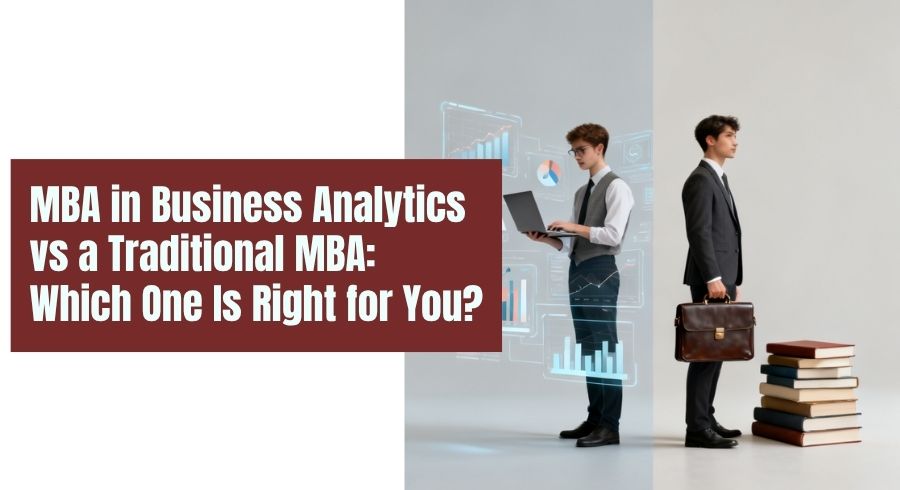
The choice between an MBA with a Business Analytics specialisation and a traditional MBA with a general or non-analytical focus is one of the most consequential academic decisions for Indian management aspirants in 2026. This article provides a structured comparison across curriculum, career outcomes, salary trajectories, recruiter preferences, and long-term growth to help students make …
MBA in Business Analytics vs. Traditional MBA: Which Is Right for You?
May 1, 2026,
4:49 pm
The MBA market in India in 2026 is not monolithic. The demand for management graduates with analytical capability has grown so significantly that the choice between a Business Analytics-focused MBA and a traditional management programme has become one of the most practically important decisions an aspirant can make. This is essentially the core of the MBA Business Analytics vs traditional MBA debate in India today.
According to NASSCOM’s Future of Tech Report, analytical and AI-related management roles are among the five fastest-growing job categories in India, with demand growing at over 30 percent annually while talent supply grows at roughly half that rate. LinkedIn’s Jobs on the Rise India Report identifies data analysis, machine learning familiarity, and business analytics as the most consistent skill demands across management roles in the country.
This context frames the comparison that follows.
What Each Programme Delivers
Traditional MBA (general or non-analytics specialisation):
A traditional MBA builds broad management capability across finance, marketing, operations, human resources, and strategy. It develops leadership thinking, cross-functional communication, and the analytical frameworks that underpin business decision-making. The learning is conceptual and strategic, with quantitative components that are sufficient for general management contexts but do not build deep data or technical capability.
MBA in Business Analytics:
An MBA with a Business Analytics specialisation builds the same management foundation but adds a second layer of applied analytical capability: working with data using tools including Python and SQL, understanding machine learning outputs and their business implications, building dashboards in Tableau or Power BI, and applying statistical methods to real business problems. The quantitative component is substantially deeper and more applied.
Curriculum Comparison
| Component | Traditional MBA | MBA with Business Analytics |
|---|---|---|
| Core management subjects | Yes | Yes |
| Quantitative methods | Basic | Advanced |
| Python or R | Not typically | Yes (for analytics specialisation) |
| Machine learning | Not typically | Yes |
| Data visualisation | Not typically | Yes (Tableau, Power BI) |
| Strategy and leadership | Yes | Yes |
| Elective depth | Broad across functions | Concentrated in analytics and data |
| AI and generative AI | Varies | Typically integrated |
At Jaipuria Institute of Management, the Business Analytics specialisation includes Python for Business Analytics, Advanced Machine Learning, Artificial Intelligence, Business Intelligence for Decision Making, Business Forecasting, Data Visualisation, Cloud Computing, Text Analytics and NLP, Digital Transformation, and Supply Chain Analytics. The mandatory core subject GenAI for Managers ensures that even students in non-analytics specialisations develop baseline AI literacy, but the Business Analytics specialisation builds substantially deeper capability.
Career Outcomes Comparison
Traditional MBA career pathways:
| Function | Typical Entry Roles |
|---|---|
| Marketing | Brand Manager (MT), Marketing Executive |
| Finance | Financial Analyst, Credit Analyst |
| HR | HR Business Partner, Talent Acquisition |
| Operations | Supply Chain Analyst, Operations Manager |
| Strategy | Business Development, Strategy Associate |
MBA Business Analytics career pathways:
| Function | Typical Entry Roles |
|---|---|
| Analytics | Business Analyst, Data Analyst, Analytics Consultant |
| Product | Product Analyst, Associate Product Manager |
| Finance | Credit Analytics, Risk Analytics, Quantitative Analyst |
| Marketing | Marketing Analytics Manager, Performance Analyst |
| Consulting | Analytics Practice Consultant |
| Technology | Business Intelligence Analyst, AI Strategy Associate |
Salary Comparison
| Specialisation | Typical Starting Salary | 5-Year Median | Demand Growth |
|---|---|---|---|
| Business Analytics | INR 10 to 22 LPA | INR 25 to 50 LPA | Very high (30%+) |
| Finance | INR 8 to 20 LPA | INR 20 to 45 LPA | Strong |
| Marketing | INR 8 to 16 LPA | INR 18 to 35 LPA | Growing |
| HR | INR 7 to 13 LPA | INR 15 to 28 LPA | Moderate |
| Operations | INR 8 to 14 LPA | INR 18 to 30 LPA | Steady |
Recruiter Preferences: What the Data Shows
| Sector | Traditional MBA Preference | Analytics MBA Preference |
|---|---|---|
| Consulting | Strong | Very strong (growing) |
| BFSI | Strong | Very strong |
| FMCG | Strong | Moderate to strong |
| E-commerce | Moderate | Very strong |
| Technology | Moderate | Very strong |
| Manufacturing | Strong | Growing |
The Case for a Traditional MBA
- You are targeting FMCG brand management, where creative strategic thinking and consumer empathy are primary differentiators
- You are pursuing a people-focused career in HR, organisational development, or change management where quantitative depth is less central
- You have strong pre-MBA quantitative experience (engineering, finance) and need to balance it with broader management exposure rather than deepen it further
- Your target roles require cross-functional breadth rather than functional depth
Traditional MBA specialisations in Marketing, HR, and Operations continue to deliver strong placement outcomes in the right sectors and companies. The issue is not that these specialisations are declining in value, it is that the baseline analytical expectation across all of them is rising, making some analytical capability important regardless of specialisation.
The Case for Business Analytics MBA
- Your career targets include consulting, BFSI analytics, product management, or data-driven marketing roles
- You have some quantitative aptitude and want to develop it into a professional differentiator
- Your target companies are in technology, e-commerce, fintech, or analytics-intensive BFSI roles
- You want the broadest possible range of placement opportunities across sectors
- You are comfortable with a steeper learning curve during the programme
The Dual Specialisation Solution
| Combination | Target Roles |
|---|---|
| Finance + Business Analytics | Credit analytics, risk analytics, fintech, investment analytics |
| Marketing + Business Analytics | Marketing analytics, e-commerce, performance marketing, D2C |
| Operations + Business Analytics | Supply chain analytics, logistics tech, operations consulting |
| HR + Business Analytics | HR analytics, talent technology, people operations |
How to Decide
| Ask yourself… | If yes, consider… |
|---|---|
| Am I comfortable with numbers and data tools? | Business Analytics specialisation |
| Do I enjoy working with people and culture? | HR or general management track |
| Do I want to work in consulting or fintech? | Business Analytics or Finance + Analytics |
| Am I targeting FMCG brand management specifically? | Marketing specialisation |
| Do I want maximum career flexibility? | Dual specialisation |
| Am I unsure between analytics and a functional area? | Dual specialisation |
Conclusion
The comparison between an MBA in Business Analytics and a traditional MBA is not a choice between a modern and an outdated programme. It is a choice between two different career trajectories, each with genuine strengths in the right context. Business Analytics delivers the highest salary premiums, the broadest sector access, and the strongest demand growth. Traditional functional specialisations remain strong in specific sectors and roles where domain depth matters more than technical breadth.
For students who can access both, through dual specialisation at institutions like Jaipuria Institute of Management, the combination delivers the most competitive profile in the current market.
Frequently Asked Questions(FAQs)
Is an MBA in Business Analytics better than a traditional MBA?
For roles in analytics, consulting, fintech, product management, and data-driven marketing, yes. For HR, brand management, and people-focused roles, a functional specialisation may be more directly aligned.
Can a non-technical student do an MBA in Business Analytics?
Yes. The programme is designed for business rather than engineering graduates and does not require prior programming knowledge. The learning curve is steeper but manageable.
Does a Business Analytics MBA limit career flexibility?
No. It expands it. Analytics capability is relevant across consulting, finance, marketing, operations, and technology, while most traditional specialisations are more sector-specific.
Which companies prefer MBA Business Analytics graduates?
E-commerce, BFSI, consulting, technology, and FMCG analytics teams are the most active hirers.
What tools does the Business Analytics specialisation at Jaipuria teach?
Python, Machine Learning frameworks, Data Visualisation (Tableau/Power BI), SQL, Business Intelligence platforms, NLP tools, and Cloud Computing, alongside the management core.
Is a dual specialisation in Finance and Business Analytics worth it?
Yes. It creates a profile that is highly competitive for credit analytics, risk analytics, fintech, and investment management roles, which are among the fastest-growing in Indian financial services.
What is the difference between an MBA in Analytics and an MCA or MSc in Data Science?
An MBA in Analytics combines business management fundamentals with analytical tools. An MCA or MSc focuses on technical depth. MBA graduates are better suited for management-facing roles; data science graduates are better suited for technical AI/ML engineering roles.
Does Jaipuria Institute of Management offer dual specialisation?
Yes. Jaipuria Institute of Management offers dual specialisation across six tracks including Business Analytics, with Finance plus Analytics and Marketing plus Analytics being the most market-aligned current combinations.
How do I know which specialisation is right for my career goals?
Map your target roles to their skill requirements, then assess your own aptitude and interest honestly. If uncertain, choose dual specialisation to retain optionality while building depth in two directions simultaneously.