



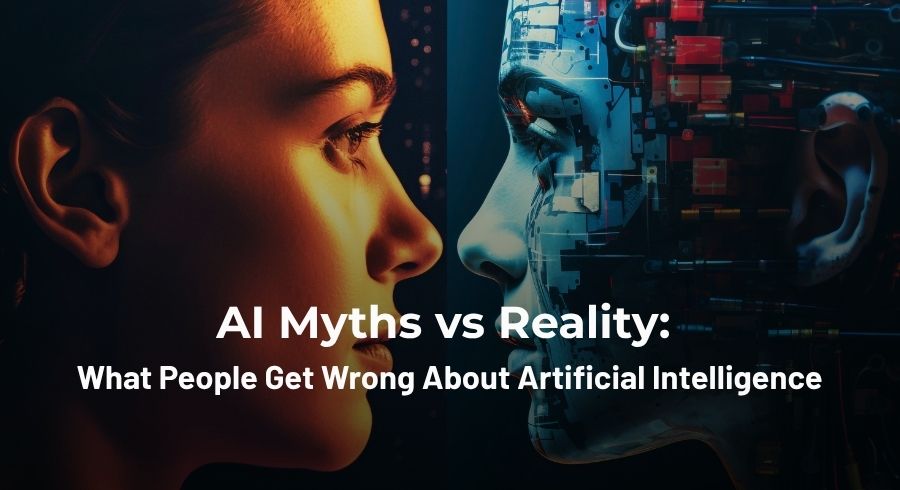
Misconceptions about artificial intelligence are widespread, ranging from fears of immediate job replacement to overestimation of AI’s current capabilities. This article separates AI myths from reality, examining what AI can genuinely do, where its limitations lie, and how businesses and students should think about AI accurately. Understanding the truth about AI is increasingly important for …
AI Myths vs Reality: What People Get Wrong About Artificial Intelligence
May 1, 2026,
3:52 pm
Table of Contents
- AI Myths vs Reality: What People Get Wrong About Artificial Intelligence
- The Most Common AI Myths, Debunked
- Myth 1: AI Will Replace All Jobs
- Myth 2: AI Is Always Right
- Myth 3: You Need to Be a Coder to Work With AI
- Myth 4: AI Understands Language the Way Humans Do
- Myth 5: AI Is a Recent Invention
- Myth 6: AI Is Completely Objective
- Myth 7: AI Will Become Conscious and Uncontrollable
- Myth 8: AI Is Only Relevant for Tech Companies
- Myth 9: AI Tools Can Replace Formal Education
- Myth 10: AI Is Too Complex for Non-Technical Professionals to Understand
- Moving Beyond the Myths
- Frequently Asked Questions (FAQs)
- Sources
Artificial Intelligence(AI) is one of the most discussed and most misunderstood technologies in the world today.
Some people overestimate what AI can do, expecting it to replace entire professions overnight. Others underestimate it, assuming it is simply an advanced calculator with no bearing on their career or industry.
Neither view is accurate. Understanding AI realistically is one of the most valuable things a student or professional can do in 2026.
Key Takeaways
- Many common beliefs about AI are misconceptions that either overestimate or underestimate its capabilities.
- AI automates tasks rather than replacing entire professions, making human skills like leadership and strategic thinking more valuable.
- AI systems can produce errors, inherit biases, and require human oversight for responsible decision-making.
- Business professionals do not need programming expertise to work effectively with AI, but AI literacy is becoming essential.
- AI is transforming industries beyond technology, including healthcare, finance, retail, manufacturing, education, and consulting.
- Future-ready business schools such as Jaipuria Institute of Management integrate AI into the curriculum to prepare students for an AI-driven economy.
The Most Common AI Myths, Debunked
Myth 1: AI Will Replace All Jobs
Reality: AI replaces tasks, not roles.
The World Economic Forum’s Future of Jobs Report projects that while AI will displace some jobs, it will also create 170 million new roles by 2030, resulting in a net positive.
What AI replaces:
- Repetitive, rule-based tasks
- Data entry and basic processing
- Standardised customer queries
What AI cannot replace:
- Strategic judgement
- Emotional intelligence and leadership
- Creative problem-solving
- Relationship management
- Ethical decision-making
The roles most at risk are those defined almost entirely by routine execution. Management roles requiring judgement and leadership are not.
Myth 2: AI Is Always Right
Reality: AI systems make errors and inherit biases.
AI models are only as good as the data they are trained on.
Common AI failure modes:
- Biased outputs from biased training data
- Overconfidence in statistically incorrect predictions
- Failure in unfamiliar or edge-case scenarios
- Inability to account for context beyond training patterns
IBM and MIT research have documented cases of significant AI error rates in facial recognition, credit scoring, and hiring tools, particularly for underrepresented groups.
Myth 3: You Need to Be a Coder to Work With AI
Reality: Most AI roles in business require analytical thinking, not programming.
Business-focused AI roles require:
- Understanding what data is available and what it can reveal
- Ability to interpret and communicate AI outputs
- Judgement about when to trust and when to question AI recommendations
- Knowledge of relevant business context
At Jaipuria Institute of Management, GenAI for Managers is a mandatory core subject for all its PGDM students regardless of specialisation, precisely because AI literacy at a business level is now a baseline professional requirement.
Myth 4: AI Understands Language the Way Humans Do
Reality: AI processes patterns, not meaning.
Large language models can generate highly fluent text and appear to understand language. In practice, they identify and reproduce statistical patterns from vast training datasets.
Implications:
- AI can produce plausible-sounding but factually incorrect statements
- It cannot reason from first principles the way humans can
- It lacks genuine comprehension, common sense, or contextual awareness beyond its training
This is why human oversight of AI-generated content and decisions remains essential in professional and organisational contexts.
Myth 5: AI Is a Recent Invention
Reality: AI has been in development since the 1950s.
Key milestones:
| Year | Development |
|---|---|
| 1956 | The term “artificial intelligence” was coined at the Dartmouth Conference |
| 1997 | IBM’s Deep Blue defeats chess champion |
| 2011 | IBM Watson wins Jeopardy |
| 2016 | AlphaGo defeats Go champion |
| 2022 | ChatGPT reaches 100 million users |
| 2026 | AI embedded across industries |
Myth 6: AI Is Completely Objective
Reality: AI reflects the biases of its creators and data.
A hiring algorithm trained on past hiring decisions that favoured particular demographic groups will tend to reproduce those biases in its recommendations. A credit scoring model trained on historical lending data may embed historical inequalities.
This is why AI ethics and governance are increasingly recognised as strategic necessities, not optional considerations.
The OECD, EU, and NASSCOM have all published frameworks emphasising fairness, transparency, and accountability as requirements for responsible AI deployment.
Myth 7: AI Will Become Conscious and Uncontrollable
Reality: Current Artificial Intelligence(AI) systems have no consciousness or self-awareness.
Generative AI and machine learning systems are pattern-matching and prediction tools. They do not have:
- Desires or intentions
- Self-awareness or consciousness
- The ability to set their own goals
- Motivation to act outside their design
While long-term AI safety is a legitimate area of research, current AI systems pose risks through misuse and misapplication, not through self-directed action.
Myth 8: AI Is Only Relevant for Tech Companies
Reality: AI is transforming every industry.
| Sector | AI Application |
| Healthcare | Diagnostic imaging, patient monitoring |
| Agriculture | Crop disease detection, precision irrigation |
| Finance | Fraud detection, credit scoring |
| Retail | Demand forecasting, personalisation |
| Education | Adaptive learning, AI tutors |
| Manufacturing | Predictive maintenance, quality control |
| Consulting | Data-driven client strategy |
Management graduates working in any of these sectors need AI literacy to perform effectively. This is why Jaipuria Institute of Management embeds AI across all specialisations, including Marketing, Finance, HR, and Operations, rather than confining it to a single technical track.
Myth 9: AI Tools Can Replace Formal Education
Reality: Artificial Intelligence(AI) tools accelerate learning; education converts it into outcomes.
Tools like ChatGPT, Claude, and Perplexity are powerful for understanding concepts, practicing skills, and working more efficiently. But formal education offers advantages that are harder to replicate independently:
- Structured access to placements and recruiters
- Peer learning, collaboration, and long-term networks
- Faculty mentorship and guided feedback
- A recognised credential that signals consistency and capability
The real edge comes from combining both: using AI to learn faster, and formal education to convert that learning into credible opportunities.
At Jaipuria Institute of Management, AI is woven into the learning experience through tools like AI-Lingo, Campus Intelligence, and immersive simulations. Combined with a full-time programme that offers industry exposure, placements, a strong alumni network, and professional development, students graduate with both AI literacy and practical business skills.
Myth 10: AI Is Too Complex for Non-Technical Professionals
Reality: Business-level AI literacy is accessible and essential.
Understanding AI does not require knowledge of mathematics or programming. It requires:
- Knowing what problems AI can and cannot solve
- Understanding how training data affects AI outputs
- Recognising when to trust and when to scrutinise AI recommendations
- Understanding basic governance and ethics requirements
This is exactly what well-designed management programmes aim to achieve. At Jaipuria Institute of Management, GenAI for Managers is a core course that equips all PGDM students with practical AI literacy, enabling them to understand, evaluate, and apply AI confidently in business, regardless of their technical background.
Moving Beyond the Myths
Understanding AI accurately matters. Overestimating it leads to unnecessary fear. Underestimating it leads to missed opportunities and inadequate preparation.
The professionals who will perform best in an AI-driven economy are those who understand what AI can genuinely do, where its limitations lie, and how to apply it responsibly within business and management contexts.
Institutions like Jaipuria Institute of Management are preparing this generation of managers through AI-native education that combines genuine technical literacy with business application, ethical reasoning, and practical placement preparation.
Frequently Asked Questions (FAQs)
Will AI really replace human jobs?
AI will change the nature of many roles and automate specific tasks, but the World Economic Forum projects a net gain in jobs as new roles are created alongside displacement.
Is Artificial Intelligence(AI) always accurate?
No. AI systems make errors, produce biased outputs, and can fail in scenarios outside their training data. Human oversight remains essential.
Do you need coding to work with AI?
No. For most business roles, AI literacy and business application are more important than coding.
Is AI biased?
AI systems can reflect biases present in their training data. Addressing this requires diverse data, rigorous testing, and ongoing monitoring.
Is AI relevant outside the technology industry?
Yes. AI is being deployed across healthcare, agriculture, finance, retail, education, and manufacturing, making AI literacy relevant for professionals in any sector.
Are fears about uncontrollable AI justified?
Current AI systems have no consciousness or self-directed goals. AI risks in 2026 arise from misuse and poor governance, not from autonomous behaviour.
Can non-technical students study AI?
Yes. Business-focused AI literacy is accessible and increasingly important for management students. Courses like GenAI for Managers at Jaipuria Institute of Management are designed for this purpose.
What is the most important thing to understand about AI in 2026?
That AI is a powerful tool with real limitations. Understanding both dimensions, what it can and cannot do, is essential for using it responsibly and effectively in professional contexts.
Sources
- Future of Jobs Report 2025
- How can we manage biases in artificial intelligence systems
- India AI Governance Guidelines
Trending AI-based Knowledge Sharing Videos of Jaipuria Institute of Management

Prem Pandey
Prem Pandey is a Digital Marketing Manager with over 20 years of experience in SEO, content marketing, lead generation, brand building, and digital growth strategies. He specializes in driving online visibility, optimizing digital campaigns, and leveraging data-driven and AI-powered marketing solutions to enhance audience engagement and business performance.
Tags
AI facts and mythsAI facts IndiaAI fears debunkedAI limitations 2026AI misconceptionsAI myths debunkedAI myths vs realityai-literacyai-mythsArtificial IntelligenceBusiness Analyticscommon AI myths IndiaDigital TransformationFuture of WorkGenAIJaipuria AI curriculumJaipuria GenAI for ManagersJaipuria Institute of ManagementJaipuria PGDM Noidamachine-learningManagement Educationmba-aitechnology-trends-indiatruth about artificial intelligence