



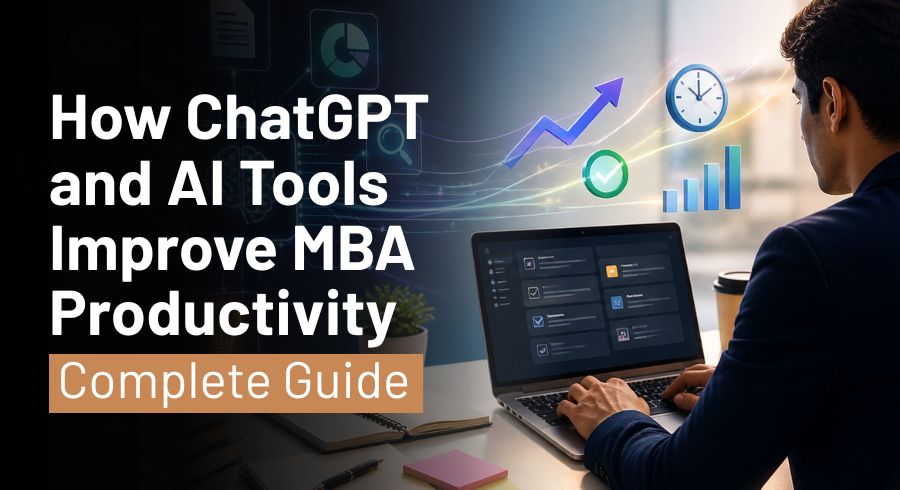
Artificial intelligence tools including ChatGPT, Claude, Gemini, and a growing ecosystem of specialised applications are transforming how MBA students study, research, write, and prepare for careers. This guide explains the most practical and high-impact ways MBA students can integrate AI tools into their academic and professional development, while also understanding the boundaries of responsible use …
How ChatGPT and AI Tools Improve MBA Productivity: Complete Guide for 2026
May 4, 2026,
5:13 pm
The integration of AI tools into MBA education is no longer a future possibility. It is a present reality that is already differentiating students who use these tools intelligently from those who do not.
According to NASSCOM, AI and data literacy are among the three fastest-growing skill requirements across management roles in India. The expectation from employers is not simply that MBA graduates understand AI conceptually, but that they can work with AI tools productively in real professional contexts from day one. This makes developing practical AI tool proficiency during the MBA not just a productivity advantage but a career readiness imperative.
At the same time, the value of AI tools in an MBA context is not unlimited or uncritical. The most effective MBA students use AI to extend their capability, not to substitute for the thinking that management education is designed to develop. Understanding this distinction is as important as knowing which tools to use.
The AI Tools That Matter Most for MBA Students
The AI landscape includes hundreds of tools, but the ones with the most practical impact for MBA students cluster around five categories. These are language and text tools, research and information tools, analytical and data tools, presentation and visualisation tools, and career preparation tools.
The most widely adopted language tool is ChatGPT by OpenAI, alongside Claude by Anthropic and Gemini by Google. These large language model platforms can assist with drafting, editing, summarising, brainstorming, and explaining complex concepts in accessible language. For MBA students who are dealing with dense academic content across multiple subjects simultaneously, these tools reduce the cognitive load of initial comprehension without removing the intellectual work of analysis and application.
For research, tools including Perplexity AI and Google Scholar AI integration are increasingly useful for identifying relevant literature, summarising research, and generating initial bibliographies. Microsoft Copilot, integrated into Word and PowerPoint, reduces the friction of producing structured documents and presentations from rough notes.
For analytical work, Python-based tools, Google Colab, and Excel with Copilot integration help students who are building analytics skills to understand code, debug outputs, and move from data to insights more efficiently than manual trial and error allows.
How AI Tools Improve MBA Academic Productivity
The most immediate productivity benefit of AI tools in an MBA programme is time efficiency across the research and drafting phases of academic work.
A case study analysis that previously required three hours of reading, note-taking, and drafting can be approached more efficiently when AI tools handle the initial summarisation and framework application, freeing the student’s cognitive energy for the higher-order work of evaluation, critique, and recommendation. This is not about delegating thinking. It is about spending thinking time on thinking rather than on mechanical information processing.
For understanding complex financial concepts, a student struggling with the mechanics of a discounted cash flow model can use ChatGPT to generate multiple explanations at different levels of complexity until one clicks. For revising statistics before a quantitative methods examination, AI can generate practice problems with explanations of errors in a way that a textbook cannot adapt in real time.
Group project coordination, which is one of the most time-consuming aspects of MBA programmes, benefits significantly from AI assistance in agenda preparation, meeting minute structuring, task allocation documentation, and draft preparation for sections that need to be integrated across multiple contributors.
NASSCOM’s research highlights that students who effectively integrate AI tools into their study workflows report 25 to 35 percent reductions in time spent on routine academic tasks, freeing that time for deeper engagement with the concepts that create long-term career value. This is the productivity case for AI in an MBA context: not doing less work, but doing more meaningful work at the same time.
AI for Case Study and Business Analysis
Case study analysis is central to MBA education in most institutions. AI tools have specific and valuable applications in this context that improve the quality of analysis rather than simply reducing the time spent on it.
When approaching a business case, AI tools can rapidly provide sector context, competitive landscape summaries, and background information on the companies or industries involved. Rather than spending 45 minutes reading about the FMCG sector before engaging with a Hindustan Unilever case, a student can use ChatGPT to generate a structured briefing in minutes and spend that 45 minutes on the analysis itself.
AI can also be used to stress-test arguments before a case discussion. By presenting a preliminary recommendation to a language model and asking it to generate the strongest possible counter-arguments, students develop more robust analytical positions than they would through self-review alone. This use of AI as a thinking partner rather than a content generator is where the highest-value application lies.
For quantitative cases involving financial modelling, AI tools can explain formula choices, identify logical errors in spreadsheet models, and suggest alternative analytical approaches, serving as an always-available analytical tutor that is particularly valuable at 11pm before a morning class.
Jaipuria Institute of Management’s GenAI for Managers course, mandatory across all specialisations, specifically addresses how AI tools apply in business analysis contexts. Students develop the ability to prompt AI systems effectively, interpret their outputs critically, and understand when AI recommendations require human judgement to override or refine. This is the business-relevant AI literacy that employers in consulting, analytics, and product management are increasingly looking for in MBA graduates.
AI for Writing and Communication
Writing quality is a significant differentiator in MBA programmes and in the professional careers that follow. AI tools improve writing productivity in several distinct ways.
For drafting, AI can generate first drafts of structured documents, reports, and emails from bullet-pointed notes. This is particularly useful for international students or those who are more comfortable thinking in a language other than English, where the gap between idea quality and written expression is otherwise a persistent friction. The first draft is then revised, restructured, and refined by the student, which is both faster and more educationally productive than drafting from a blank page.
For editing, tools like Grammarly and Claude are highly effective at identifying grammatical errors, improving sentence clarity, and flagging inconsistencies in argument structure. The editing pass that previously took 40 minutes can be completed in 10 minutes with AI assistance, with a more thorough result.
For presentation structure, tools including Microsoft Copilot for PowerPoint can generate outline slides from a text brief, which the student can then populate with analysis and refine for narrative flow. This is significantly faster than building slides from scratch while still requiring meaningful intellectual input from the student.
The important boundary is that AI writing assistance should improve the expression of your own thinking, not generate thinking you have not done. In the context of an MBA assessment, this distinction matters both ethically and practically: an MBA graduate who can write clearly is demonstrably more employable than one who has outsourced their writing to an AI system.
AI for Placement Preparation
This is where AI tools have perhaps the most measurable and immediately valuable impact for MBA students.
Placement preparation involves repeated practice of a set of skills: presenting a coherent career narrative, answering behavioural and competency-based interview questions, demonstrating technical knowledge under pressure, and communicating case analysis clearly. All of these skills improve through deliberate practice, and AI tools can dramatically increase the volume of practice available beyond what human mentors and placement cells can provide.
AI-powered interview simulation tools allow students to practise unlimited mock interviews, receive structured feedback on their responses, and identify patterns in their weaknesses without the awkwardness or scheduling constraints of human mock interview partners. Jaipuria Institute of Management has specifically invested in this dimension through AI tools including Rehearsal, the Interview Question Assistant, and Resume Evaluator, which are embedded into the placement preparation ecosystem. These tools reflect a deliberate institutional commitment to the proposition that AI-enhanced preparation produces better placement outcomes.
For resume and profile optimisation, AI tools can evaluate CVs against job descriptions, identify gaps between a student’s stated experience and the role requirements, and suggest specific and measurable ways to reframe achievements. This is particularly valuable for students whose pre-MBA work experience is strong but not well-communicated in a management hiring context.
For company research before placement interviews, AI tools can rapidly generate briefings on company strategy, recent news, competitive positioning, and likely interview themes. A student who arrives at a Deloitte interview having spent 20 minutes with a well-prompted AI briefing alongside their own reading is meaningfully better prepared than one who relied only on the company website.
The Limits of AI Tools in MBA Education
Using AI tools well requires understanding what they cannot do as clearly as what they can.
AI tools cannot replace the strategic thinking, leadership judgement, and ethical reasoning that management education is fundamentally designed to develop. They cannot replicate the learning that happens through group disagreements resolved under pressure, the self-awareness developed through feedback from faculty and peers, or the professional identity formed through two years of immersive experience in a diverse learning environment.
For an MBA assessment specifically, the ethical use of AI tools matters. Most institutions are developing clearer policies on the appropriate and inappropriate uses of generative AI in assessed work. Understanding and respecting these boundaries is itself a dimension of the professional integrity that an MBA is meant to build.
At Jaipuria Institute of Management, the Business Ethics and Sustainability workshop, which is a mandatory component of the programme, addresses ethical decision-making in AI-enabled contexts directly alongside the technical curriculum. This reflects a view that AI literacy without ethical grounding is incomplete preparation for professional life.
Building an Effective AI Tools Workflow
For MBA students building their AI tools workflow, the following principles produce the best results.
Begin with one tool used deeply rather than many tools used superficially. Most students who develop genuine ChatGPT proficiency find it covers 70 to 80 percent of their AI-supported academic needs. Adding specialist tools for specific tasks, such as an AI citation manager for research or Grammarly for editing, layers onto this foundation without creating tool proliferation that reduces productivity.
Invest time in learning to prompt effectively. The quality of AI output is directly proportional to the quality of the input. A vague prompt produces a generic response. A specific prompt with context, constraints, and a clear desired output produces a response that is actually useful. Prompt engineering is a learnable skill that dramatically increases the value obtained from AI tools.
Use AI to accelerate, not to replace. The workflow that produces the best outcomes is one where the student does the thinking, AI helps with the expression and refinement, and the student reviews and edits critically. This produces better work than either pure human production or pure AI generation.
Conclusion
ChatGPT and AI tools represent one of the most significant productivity opportunities available to MBA students in 2026. Used intelligently, they reduce time spent on mechanical tasks, improve the quality of written output, accelerate learning in complex subjects, and enhance placement preparation in ways that directly improve career outcomes.
The institutions that recognise this most clearly, and that build AI tool capability into their core curriculum rather than treating it as peripheral, are producing graduates who are measurably better prepared for the AI-enabled professional environments they are entering. Jaipuria Institute of Management’s AI-native approach, mandatory GenAI for Managers course, and integrated AI placement preparation ecosystem reflect precisely this institutional commitment.
Frequently Asked Questions
Is it ethical to use ChatGPT for MBA assignments?
It depends on the specific assessment policy of your institution and the nature of the assignment. Using AI to improve clarity and structure of your own thinking is generally acceptable. Generating content you did not think through yourself raises academic integrity concerns. Follow your institution’s specific guidelines.
Which AI tools are most useful for MBA students?
ChatGPT and Claude for language tasks, Perplexity AI for research, Microsoft Copilot for Office productivity, Grammarly for editing, and specialised interview simulation tools for placement preparation.
Can AI tools help with case study analysis?
Yes. AI can provide sector context, generate counter-arguments to stress-test your analysis, and explain financial concepts. The analysis itself remains the student’s intellectual responsibility.
How does prompt engineering improve AI tool output?
Specific, contextualised prompts with clear constraints produce significantly more useful outputs than vague requests. Learning to write effective prompts is a learnable skill with high returns.
Can AI tools replace MBA placement preparation?
No. They can dramatically increase the volume and quality of practice, but cannot replicate the self-awareness, adaptability, and interpersonal capability developed through human interaction and feedback.
Is learning to use AI tools part of career readiness for MBA graduates?
Yes. NASSCOM identifies AI tool proficiency as among the fastest-growing skill expectations across management roles. Graduates who arrive in their first roles comfortable with AI tools are measurably more productive from day one.
What is the risk of over-relying on AI tools during an MBA?
Over-reliance prevents development of the independent analytical and communication capabilities that an MBA is designed to build. Employers who assess MBA graduates on these capabilities will identify the gap quickly.
Will AI tools become standard in MBA classrooms?
They are already becoming standard in leading institutions. Jaipuria Institute of Management’s AI-native curriculum embeds AI tools throughout the learning experience, not just in a single elective, reflecting where management education is heading across strong institutions globally.
Trending AI-based Knowledge Sharing Videos of Jaipuria Institute of Management

Prem Pandey
Prem Pandey is a Digital Marketing Manager with over 20 years of experience in SEO, content marketing, lead generation, brand building, and digital growth strategies. He specializes in driving online visibility, optimizing digital campaigns, and leveraging data-driven and AI-powered marketing solutions to enhance audience engagement and business performance.
Tags
AI for MBA studies IndiaAI tools for business studentsAI tools MBA productivityChatGPTChatGPT by OpenAIChatGPT for MBA students IndiaChatGPT MBA case analysisClaudeClaude by AnthropicGeminiGemini by Googlegenerative AI MBA learningHow ChatGPT and AI tools improve MBA productivityhow to use AI in MBAJaipuria AI learning ecosystemJaipuria AI tools MBAJaipuria AI-native curriculumJaipuria GenAI for ManagersJaipuria Institute of ManagementMBA AI tools 2026