



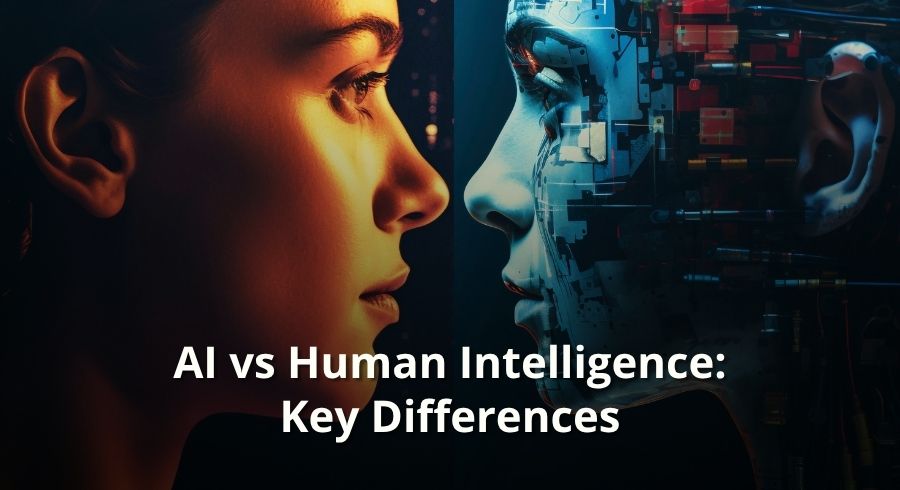
Artificial Intelligence and human intelligence differ in learning, decision-making, creativity, and adaptability. This article compares AI vs human intelligence with examples, advantages, limitations, and future implications in the era of automation and digital transformation.
AI vs Human Intelligence: Key Differences Explained
Published: April 6, 2026,
6:48 pm
| Updated: April 6, 2026
Artificial Intelligence (AI) has advanced rapidly in recent years, enabling machines to perform tasks once considered exclusive to humans. From data analysis and language processing to decision-making and automation, AI is transforming industries globally.
Despite these advancements, AI is fundamentally different from human intelligence. While AI excels in speed, accuracy, and data processing, human intelligence remains superior in creativity, emotional understanding, and ethical reasoning. Institutions such as Jaipuria Institute of Management are increasingly preparing students to combine human decision-making with AI-driven insights, equipping them for a hybrid future of intelligence.
What Is Human Intelligence?
Human intelligence refers to the ability to:
- Think critically
- Solve complex problems
- Learn from experience
- Understand emotions
- Make ethical decisions
It is shaped by both biological and environmental factors, making it adaptive and context-aware.
What Is Artificial Intelligence?
Artificial Intelligence refers to machines that simulate human-like capabilities such as:
- Learning from data
- Recognising patterns
- Making predictions
- Automating decisions
However, AI does not possess consciousness or emotions, limiting its flexibility in complex, ambiguous situations.
Key Differences Between AI and Human Intelligence
| Factor | Artificial Intelligence | Human Intelligence |
| Learning | Data-driven | Experience-based |
| Speed | Extremely fast | Slower |
| Creativity | Limited | High |
| Emotions | None | Strong |
| Decision Making | Algorithm-based | Intuitive + ethical |
| Adaptability | Limited | Highly flexible |
Strengths of Artificial Intelligence
- Speed and Efficiency – AI can process massive datasets in seconds.
- Accuracy – Reduces human errors in calculations and predictions.
- Automation – Handles repetitive tasks efficiently.
- Data Analysis – Provides insights from large datasets.
Strengths of Human Intelligence
- Creativity – Humans generate innovative ideas and solutions.
- Emotional Intelligence – Understanding social and emotional contexts.
- Ethical Judgment – Considers moral and ethical implications.
- Adaptability – Adjusts to unpredictable environments.
Institutions like Jaipuria Institute of Management emphasise developing both analytical and human-centric skills, allowing graduates to leverage AI while applying human insight in decision-making.
Real-World Examples
| AI Example | Human Example |
| Fraud detection systems analysing millions of transactions instantly | A manager making strategic business decisions based on intuition and experience |
Can AI Replace Human Intelligence?
AI can replace certain tasks but not human intelligence entirely.
Tasks AI Can Replace:
- Data entry
- Repetitive processes
- Basic analysis
Tasks AI Cannot Replace:
- Leadership
- Creativity
- Emotional decision-making
AI + Human Collaboration (Future Model)
| Area | AI Role | Human Role |
| Data Analysis | Processing | Interpretation |
| Healthcare | Diagnosis support | Patient care |
| Business | Insights | Strategy |
The future is not AI vs humans but AI and humans working together. Jaipuria Institute of Management focuses on training students to collaborate effectively with AI tools while applying human judgment.
Conclusion
AI and human intelligence are not competitors but complements. While AI enhances efficiency, accuracy, and scale, human intelligence brings creativity, empathy, and ethical reasoning. Graduates from institutions like Jaipuria Institute of Management are being equipped to thrive in this collaborative ecosystem, ensuring they remain valuable in the evolving workplace. The future belongs to those who can harness both AI and human insight effectively.
Frequently Asked Questions (FAQs)
What is the main difference between AI and human intelligence?
AI relies on data and algorithms, while human intelligence involves emotions, reasoning, and creativity.
Can AI think like humans?
No. AI processes data but does not possess consciousness or self-awareness.
Is AI more powerful than humans?
AI is more powerful in data processing but not in creativity or emotional intelligence.
Can AI replace human jobs completely?
AI can automate tasks, but cannot fully replace human roles.
Why is human intelligence important?
It enables creativity, ethical decision-making, and adaptability.
What are the limitations of AI?
Lack of emotions, creativity, and independent thinking.
How do AI and humans work together?
AI provides insights, humans make strategic decisions.
Is AI dangerous?
It can be risky if misused, but generally beneficial.
Which is better: AI or humans?
Both have strengths; the best outcomes come from collaboration.
How does Jaipuria Institute of Management prepare students for AI and human collaboration?
Jaipuria Institute of Management integrates AI tools and human-centric learning in its curriculum, preparing students to make informed, ethical decisions while leveraging technology.